
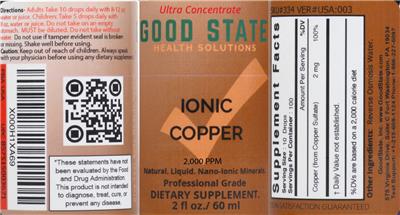
| Copper (as Copper Sulfate) | 2 mg | 100% |
Other ingredients: reverse osmosis Water
% Daily Values for: Adults and children 4 or more years of age; Children less than 4 years of age.
Where this label comes from
An original label of the NIH's Dietary Supplement Label Database, entered there on 24 October 2022, shown here as it was entered. The NIH's record · picture of the label (PDF)
General information
- Product name
- Ionic Copper 2,000 PPM
- Brand
- Good State
- Barcode (UPC)
- 8 57515 00367 1
- Net contents
- 2 Fluid Ounce(s); 60 mL
- Market status
- On market
- DSLD ID
- 276942
Classification
Label statements
Directions: Directions - Adults take 10 drops daily with 8-12 oz water or juice. Children: Take 5 drops daily with 8 oz, water or juice. Do not take on an empty stomach. Must be diluted. Do not take without water.
Precautions: All Other: Do not use if tamper evident seal is broken or missing.
Directions: Shake well before using.
Precautions: Children: Caution: Keep out of reach of children.
Precautions: All Other: Always speak with your physician before using any dietary supplement.
Formula: Contains: Nano-Ionic Minerals.
FDA Statement of Identity: Dietary Supplement.
Brand information
Manufacturer: GoodState, Inc., Fort Washington, PA
More labels from Good State
Labels only: each label is shown as printed on the bottle, with no grades, rankings or advice. A label in this database is not an endorsement of the product. Read the label on the bottle you buy: makers change their formulas. Reverse Age Lab is not affiliated with, or endorsed by, the National Institutes of Health or its Office of Dietary Supplements. The original labels come from the NIH’s public-domain data; the labels since are read by us. Search the Dietary Supplement Label Database.