
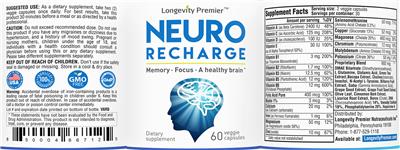
| Vitamin A (as Beta-Carotene) | 2,400 IU | 48% |
| Vitamin C (as Ascorbic Acid) | 125 mg | 208% |
| Vitamin D (as Cholecalciferol) | 100 IU | 25% |
| Vitamin E (as DL-Alpha-Tocopheryl)DL-Alpha Tocopheryl 50% | 30 IU | 100% |
| Vitamin B1 (as Thiamine Mononitrate) | 3 mg | 200% |
| Vitamin B2 (as Riboflavin) | 1.7 mg | 100% |
| Vitamin B3 (as Niacin) | 12.5 mg | 62% |
| Vitamin B5 (as Pantothenic Acid) | 12 mg | 120% |
| Vitamin B6 (as Pyridoxal Phosphate) | 12 mg | 600% |
| Folic Acid, Pure | 400 mcg | 100% |
| Biotin1% | 3 mcg | 3% |
| Calcium (as Calcium Carbonate) | 20 mg | 2% |
| Iron (as Ferrous Fumarate) | 1 mg | 6% |
| Magnesium (as Magnesium Oxide)Magnesium Oxide 58% | 50 mg | 12% |
| Zinc (as Zinc Oxide) | 10 mg | 67% |
| Selenomethionine (as Selenium Amino Acid Chelate)Selenium Amino Acid Chelate 0.2% | 50 mcg | 71% |
| Copper (as Copper Gluconate)Copper Gluconate 13% | 52 mcg | 3% |
| Manganese (as Manganese Chelate)Manganese Chelate 20% | 400 mcg | 20% |
| Chromium (as Chromium Picolinate) | 12 mcg | 10% |
| Molybdenum (as Molybdenum Amino Acid Chelate) | 10 mcg | 20% |
| Potassium (as Potassium Citrate)Potassium Citrate 36% | 50 mg | 1.4% |
| Proprietary Blend | 692 mg | † |
| DMAE Bitartrate | ||
| L Glutamine | ||
| Glutamic Acid | ||
| Green Tea extract | ||
| Bacopa extract | ||
| Choline (as Choline Bitartrate) | ||
| Inositol | ||
| N-Acetyl L-Tyrosine | ||
| Bilberry Fruit Extract | ||
| GABA | ||
| Grape seed extract | ||
| Grape Extract (as Grape fruit extract, Grape seed extract) | ||
| Olive | ||
| Cinnamon bark extract | ||
| Licorice root extract | ||
| Boron (as Boron Citrate) | ||
| Docosahexaenoic Acid14% | ||
| Vanadyl Sulfate19% | ||
| Phosphatidylserine20% | ||
| Huperzine A |
% Daily Values for: Adults and children 4 or more years of age.
Where this label comes from
An original label of the NIH's Dietary Supplement Label Database, entered there on 22 November 2022, shown here as it was entered. The NIH's record · picture of the label (PDF)
General information
- Product name
- Neuro Recharge
- Brand
- Longevity Premier
- Barcode (UPC)
- 8 50004 66712 5
- Net contents
- 60 Veggie Capsule(s)
- Market status
- On market
- DSLD ID
- 277561
Classification
- Supplement form
- Capsule
- Product type
- Other Combinations
- Claim types on the label
- All Other, Structure/Function
- Intended for
- Adult (18 - 50 Years)
Label statements
Directions: Suggested use: As a dietary supplement, take two (2) veggie capsules once daily. For best results, take this product 30 minutes before a meal or as directed by a health professional.
Precautions: All Other: Caution: Do not exceed recommended dose.
Precautions: All Other: Do not use this product if you have any migraines or dizziness due to hypertension, and a history of mood swing.
Precautions: Pregnant or Nursing or Prescription Medications: Pregnant or nursing mothers, children under the age of 18, and individuals with a known health condition should consult a physician before using this or any dietary supplement.
Precautions: All Other: Please take different supplements separately.
Precautions: Children: Keep out of reach of children.
Precautions: All Other: Don't use if the safety seal is damaged or missing.
Storage: Store in a cool & dry place.
Formulation: Does NOT Contain: GMO free
Precautions: Children: Warning: Accidental overdose of iron-containing products is a leading cause of fatal poisoning in children under six. Keep this product out of reach of children. In case of accidental overdose, call a doctor or poison control center immediately.
FDA Statement of Identity: Dietary Supplement
Brand information
Distributed by: Longevity Premier Nutraceuticals Inc, Philadelpia, Pennsylvania
More labels from Longevity Premier
Labels only: each label is shown as printed on the bottle, with no grades, rankings or advice. A label in this database is not an endorsement of the product. Read the label on the bottle you buy: makers change their formulas. Reverse Age Lab is not affiliated with, or endorsed by, the National Institutes of Health or its Office of Dietary Supplements. The original labels come from the NIH’s public-domain data; the labels since are read by us. Search the Dietary Supplement Label Database.