
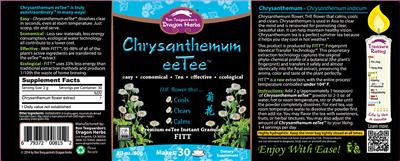
| Chrysanthemum flower extract | † |
Other ingredients: Maltodextrin
% Daily Values for: Adults and children 4 or more years of age.
Where this label comes from
An original label of the NIH's Dietary Supplement Label Database, entered there on 13 December 2022, shown here as it was entered. The NIH's record · picture of the label (PDF)
General information
- Product name
- Chrysanthemum eeTee
- Brand
- Ron Teeguarden's Dragon Herbs
- Barcode (UPC)
- 6 79372 00815 2
- Net contents
- 2.1 Ounce(s); 60 Gram(s)
- Market status
- On market
- DSLD ID
- 278979
Classification
Label statements
Precautions: Allergies: May contain a trace amount of non-GMO organic maize.
Formulation: Does NOT Contain: Laboratory tested gluten-free.
FDA Statement of Identity: Dietary Supplement
Formula: Contains: Chrysanthemum - Chrysanthemum indicum Chrysanthemum flower, the flower that calms, cools and clears. Chrysanthemum is used in Asia to clear the mind and is renowned for promoting clear, beautiful skin. It can help maintain healthy vision. Chrysanthemum tea is a perfect summer tea because it helps you stay cool in hot weather.
Directions: Instructions: Add 2 g (approximately 1 teaspoon) of Chrysanthemum eeTee powder to 2-3 oz. of water, hot or room temperature, stir or shake until the powder completely dissolves. For iced tea, use room temperature water to dissolve the powder first then add ice. You may flavor the tea with sweeteners, fruits, or herbal tinctures. You may also adjust the amount of Chrysanthemum eeTee to your liking. 1-4 servings per day.
Storage: Highly hydrophillic. Keep the inner bag tightly closed at all times.
Brand information
Manufactured by: Ron Teeguarden's Dragon Herbs, Los Angeles, CA
More labels from Ron Teeguarden's Dragon Herbs
Labels only: each label is shown as printed on the bottle, with no grades, rankings or advice. A label in this database is not an endorsement of the product. Read the label on the bottle you buy: makers change their formulas. Reverse Age Lab is not affiliated with, or endorsed by, the National Institutes of Health or its Office of Dietary Supplements. The original labels come from the NIH’s public-domain data; the labels since are read by us. Search the Dietary Supplement Label Database.