
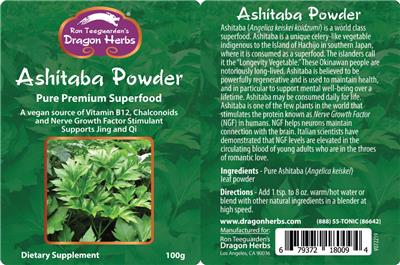
| Ashitaba, Powder, Pure |
% Daily Values for: Adults and children 4 or more years of age.
Where this label comes from
An original label of the NIH's Dietary Supplement Label Database, entered there on 13 December 2022, shown here as it was entered. The NIH's record · picture of the label (PDF)
General information
- Product name
- Ashitaba Powder
- Brand
- Ron Teeguarden's Dragon Herbs
- Barcode (UPC)
- 6 79372 18009 4
- Net contents
- 100 Gram(s)
- Market status
- On market
- DSLD ID
- 279289
Classification
Label statements
FDA Statement of Identity: Dietary Supplement
Formula: Contains: Ashitaba (Angelica keiskei koidzumi) is a world class superfood. Ashitaba is a unique celery-like vegetable indigenous to the Island of Hachijo in southern Japan, where it is consumed as a superfood. The islanders call it the "Longevity Vegetable." These Okinawan people are notoriously long-lived. Ashitaba is believed to be powerfully regenerative and is used to maintain health, and in particular to support mental well-being over a lifetime.Ashitaba may be consumed daily for life. Ashitaba is one of the few plants in the world that stimulates the protein known as Nerve Growth Factor (NGF) in humans. NGF helps neurons maintain connection with the brain. Italian scientists have demonstrated that NGF levels are elevated in the circulating blood of young adults who are in the throes of romantic love.
Directions: Directions - Add 1 tsp. to 8 oz. warm/hot water or blend with other natural ingredients in a blender at high speed.
Brand information
Manufactured for: Ron Teeguarden's Dragon Herbs, Los Angeles, CA
More labels from Ron Teeguarden's Dragon Herbs
Labels only: each label is shown as printed on the bottle, with no grades, rankings or advice. A label in this database is not an endorsement of the product. Read the label on the bottle you buy: makers change their formulas. Reverse Age Lab is not affiliated with, or endorsed by, the National Institutes of Health or its Office of Dietary Supplements. The original labels come from the NIH’s public-domain data; the labels since are read by us. Search the Dietary Supplement Label Database.