
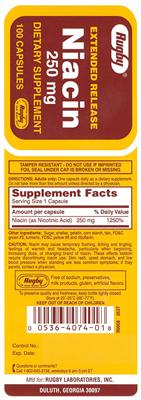
| Niacin (as Nicotinic Acid)Niacin (Form: as Nicotinic Acid) | 250 mg | 1,250% |
Other ingredients: Sugar, Shellac, Gelatin, Corn Starch, Talc, FD&C green #3, Turmeric, FD&C yellow #6, Riboflavin
% Daily Values for: Adults and children 4 or more years of age.
Where this label comes from
An original label of the NIH's Dietary Supplement Label Database, entered there on 24 December 2013, shown here as it was entered. The NIH's record
General information
- Product name
- Extended Release Niacin 250 mg
- Brand
- Rugby
- Barcode (UPC)
- 0 0536-4074-01 8
- Net contents
- 100 Capsule(s)
- Market status
- Off market
- DSLD ID
- 28335
Classification
Label statements
FDA Statement of Identity: DIETARY SUPPLEMENT
Precautions: All Other: TAMPER RESISTANT - DO NOT USE IF IMPRINTED FOIL SEAL UNDER CAP IS BROKEN OR MISSING
Directions: DIRECTIONS: Adults only: One capsule daily as a dietary supplement. Do not take more than this amount unless directed by a physician.
Precautions: All Other: CAUTION: Niacin may cause temporary flushing, itching and tingling, feelings of warmth and headache, particularly when beginning, increasing dose, or changing brand of niacin. These effects seldom require discontinuing niacin use. Skin rash, upset stomach, and low blood pressure when standing are less common symptoms; if they persist, contact a physician.
Formulation: Does NOT Contain: Free of sodium, preservatives, milk products, gluten, artificial flavors.
Storage: To preserve quality and freshness, keep bottle tightly closed. Store between 20(0)-25(0)C (68(0)-77(0)F).
Precautions: Children: KEEP OUT OF REACH OF CHILDREN
Brand information
Mfd for:: RUGBY LABORATORIES, INC., DULUTH, GEORGIA
More labels from Rugby
Labels only: each label is shown as printed on the bottle, with no grades, rankings or advice. A label in this database is not an endorsement of the product. Read the label on the bottle you buy: makers change their formulas. Reverse Age Lab is not affiliated with, or endorsed by, the National Institutes of Health or its Office of Dietary Supplements. The original labels come from the NIH’s public-domain data; the labels since are read by us. Search the Dietary Supplement Label Database.