
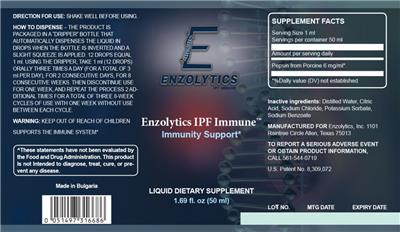
| Pepsin (as Porcine)6 mg/ml | 6 mg | † |
Other ingredients: Water, Distilled, Citric Acid, Sodium Chloride, Potassium Sorbate, Sodium Benzoate
% Daily Values for: Adults and children 4 or more years of age.
Where this label comes from
An original label of the NIH's Dietary Supplement Label Database, entered there on 21 February 2023, shown here as it was entered. The NIH's record · picture of the label (PDF)
General information
- Product name
- Enzolytics IPF Immune
- Brand
- Enzolytics
- Barcode (UPC)
- 0 051497 316686
- Net contents
- 1.69 Fluid Ounce(s); 50 mL
- Market status
- On market
- DSLD ID
- 284177
Classification
- Supplement form
- Liquid
- Product type
- Non-Nutrient/Non-Botanical
- Claim types on the label
- All Other, Structure/Function
- Intended for
- Adult (18 - 50 Years)
Label statements
Directions: Directions for Use: Shake well before using. How to Dispense: The product is packaged in a "dripper" bottle that automatically dispenses the liquid in drops when the bottle is inverted and a slight squeeze is applied. 12 drops equal 1 mL. using the dripper, take 1 mL (12 drops) orally three times a day (For a total of 3 mL per day), for 2 consecutive days, for 8 consecutive weeks. Then discontinue use for one week, and repeat the process 2 additional times for a total of three 8-week cycles of use with one week without use between each cycle.
Precautions: Children: Warning: Keep out of reach of children.
FDA Statement of Identity: Liquid Dietary Supplement
Precautions: All Other: To report a serious adverse event or obtain product information, call 561-544-0719
Brand information
Manufactured for: Enzolytics, Inc, Allen, Texas
Labels only: each label is shown as printed on the bottle, with no grades, rankings or advice. A label in this database is not an endorsement of the product. Read the label on the bottle you buy: makers change their formulas. Reverse Age Lab is not affiliated with, or endorsed by, the National Institutes of Health or its Office of Dietary Supplements. The original labels come from the NIH’s public-domain data; the labels since are read by us. Search the Dietary Supplement Label Database.