
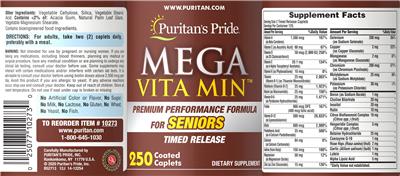
| Vitamin A (as Beta-Carotene) | 1,500 mcg | 167% |
| Vitamin C (as Ascorbic Acid) | 60 mg | 67% |
| Vitamin D (as Cholecalciferol, Vitamin D3)2000 IU | 50 mcg | 250% |
| Vitamin E (as D-Alpha-Tocopheryl Acetate) | 20.1 mg | 134% |
| Vitamin K (as Phytonadione) | 10 mcg | 8% |
| Thiamine (as Thiamine Mononitrate, Vitamin B1) | 25 mg | 2,083% |
| Riboflavin (as Vitamin B2) | 25 mg | 1,923% |
| Niacin (as Niacinamide) | 25 mg | 156% |
| Vitamin B6 (as Pyridoxine Hydrochloride) | 25 mg | 1,471% |
| Folate | 666 mcg DFE | 167% |
| Folic Acid | 400 mcg | |
| Vitamin B12 (as Cyanocobalamin) | 500 mcg | 20,833% |
| Biotin | 600 mcg | 2,000% |
| Pantothenic Acid (as D-Calcium Pantothenate) | 25 mg | 500% |
| Calcium (as Calcium Carbonate) | 84 mg | 6% |
| Iodine (as Kelp) | 150 mcg | 100% |
| Magnesium (as Magnesium Oxide) | 50 mg | 12% |
| Zinc (as Zinc Gluconate) | 15 mg | 136% |
| Selenium (as Sodium Selenate) | 200 mcg | 364% |
| Copper (as Copper Gluconate) | 2 mg | 222% |
| Manganese (as Manganese Gluconate) | 2 mg | 87% |
| Chromium (as Chromium Picolinate) | 200 mcg | 571% |
| Molybdenum (as Sodium Molybdate) | 25 mcg | 56% |
| Potassium (as Potassium Chloride) | 30 mg | <1% |
| Boron (as Sodium Borate) | 1 mg | † |
| Choline Bitartrate | 20 mg | † |
| Inositol | 20 mg | † |
| Rutin | 10 mg | † |
| Citrus Bioflavonoid Complex (as Citrus spp.) | 10 mg | † |
| Hesperidin Complex (as as Citrus spp.) | 5 mg | † |
| Betaine Hydrochloride | 25 mg | † |
| Coenzyme Q-10 | 1 mg | † |
| Rose Hips | 2 mg | † |
| Garlic | 1 mg | † |
| Lutein | 1 mg | † |
| Alpha Lipoic Acid | 5 mg | † |
Other ingredients: Cellulose, Silica, Stearic Acid, Acacia Gum, natural Palm leaf glaze, Magnesium Stearate
% Daily Values for: Adults and children 4 or more years of age.
Where this label comes from
An original label of the NIH's Dietary Supplement Label Database, entered there on 24 May 2023, shown here as it was entered. The NIH's record · picture of the label (PDF)
General information
- Product name
- Mega Vita Min for Seniors
- Brand
- Puritan's Pride
- Barcode (UPC)
- 0 25077 10273 0
- Net contents
- 250 Coated Caplet(s)
- Market status
- On market
- DSLD ID
- 285052
Classification
- Supplement form
- Other (e.g. tea bag)
- Product type
- Other Combinations
- Claim types on the label
- All Other, Structure/Function
- Intended for
- Seniors/Mature (>50 Years), Gluten Free, Dairy Free, Sugar Free
Label statements
Precautions: Allergies: Contains bioengineered food ingredients.
Directions: Directions: For adults, take two (2) caplets daily, preferably with a meal.
Precautions: Pregnant or Nursing or Prescription Medications: Warning: Not intended for use by pregnant or nursing women. If you are taking any medications, including blood thinners, planning any medical or surgical procedure, have any medical condition or are planning to undergo any clinical lab testing, consult your doctor before use. Some supplements may interact with certain medications and/or interfere with certain lab tests.
Precautions: All Other: It is advisable to consult your doctor before using biotin doses above 2,500 mcg per day.
Precautions: Allergies: Avoid this product if you are allergic to yeast.
Precautions: All Other: If any adverse reactions occur, stop use and consult your doctor.
Precautions: Children: Keep out of reach of children.
Storage: Store at room temperature.
Precautions: All Other: Do not use if seal under cap is broken or missing.
Formulation: Does NOT Contain: No artificial color or flavor, no sugar, no milk, no lactose, no gluten, no wheat no yeast, no fish.
FDA Statement of Identity: Dietary Supplement
Brand information
Carefully Manufactured by: Puritan's Pride, Inc., Ronkonkoma, NY, U.S.A.
More labels from Puritan's Pride
Labels only: each label is shown as printed on the bottle, with no grades, rankings or advice. A label in this database is not an endorsement of the product. Read the label on the bottle you buy: makers change their formulas. Reverse Age Lab is not affiliated with, or endorsed by, the National Institutes of Health or its Office of Dietary Supplements. The original labels come from the NIH’s public-domain data; the labels since are read by us. Search the Dietary Supplement Label Database.