
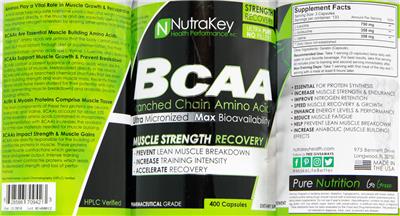
| L-Leucine | 750 mg | † |
| L-Isoleucine | 358 mg | † |
| L-Valine | 358 mg | † |
Other ingredients: Gelatin
% Daily Values for: Adults and children 4 or more years of age.
Where this label comes from
An original label of the NIH's Dietary Supplement Label Database, entered there on 22 June 2023, shown here as it was entered. The NIH's record · picture of the label (PDF)
General information
- Product name
- BCAA
- Brand
- NutraKey Health Performance
- Barcode (UPC)
- 6 28586 70942 3
- Net contents
- 400 Capsule(s)
- Market status
- On market
- DSLD ID
- 287384
Classification
- Supplement form
- Capsule
- Product type
- Amino acid/Protein
- Claim types on the label
- Nutrient, All Other, Structure/Function
- Intended for
- Adult (18 - 50 Years), Gluten Free, Dairy Free, Sugar Free
Label statements
Formula: Contains: Aminos play a vital role in muscle growth & recuperation Amino acids help regulate hormone production and weight management. BCAAs are metabolized directly in the muscle and are especially useful to athletes because it may improve nitrogen retention by sparing other amino acid groups for repair and rebuilding. “Essential” amino acids are aminos that the body cannot produce on its own, but must obtain through diet or supplementation. The three branched chain amino acids are L-Valine, L-Leucine, and L-isoleucine. BCAAs support muscle growth & prevent breakdown BCAAs contain a potent balance of amino acids which are the building blocks of muscle. Metabolized directly in the muscle, BCAAs are unique branched chemical structures that are essential in building strength and lean muscle mass. Recently these amino acids have been studied for their potential anti-catabolic (preventing muscle breakdown) and anabolic (muscle building) effects. Actin & myosin proteins comprise muscle tissue The main components of these two proteins are leucine, isoleucine, and valine. BCAAs account for about 35% of the essential amino acids contained in myoproteins. Supplementation with BCAAs increases the availability of the raw materials needed for muscle building. BCAAs impact strength & muscle gains BCAAs are directly responsible for the building of contractile proteins in muscle. These proteins cause muscle contractions which generate force and power output. Intense training breaks down contractile proteins which leads to decreased strength and loss of performance.
Formulation: Does NOT Contain: Ultra pure no fillers
Formula: Contains: Branched chain amino acids
FDA Statement of Identity: Dietary Supplement
Directions: Recommended use: take 1 serving (3 capsules) twice daily with water or your favorite beverage. For best results, take first serving 60 minutes prior to training and second serving immediately after. Non-training days: take 1 serving with first meal of the day and 1 serving with a meal at least 6 hours later.
Precautions: Pregnant or Nursing or Prescription Medications: Warning: pregnant or lactating women, diabetics, hypoglycemic, and people with known medical conditions and/or taking drugs should consult with a licensed physician and/or pharmacist prior to taking dietary supplements.
Precautions: All Other: Do not use if seal is broken.
Formulation: Does NOT Contain: Hypoallergenic: contains no yeast, dairy, egg, gluten, corn, soy, wheat, sugar, starch, salt, preservatives, or artificial color, flavor, or fragrance.
Brand information
Manufacturer: Nutrakey, Longwood, FL
More labels from NutraKey Health Performance
Labels only: each label is shown as printed on the bottle, with no grades, rankings or advice. A label in this database is not an endorsement of the product. Read the label on the bottle you buy: makers change their formulas. Reverse Age Lab is not affiliated with, or endorsed by, the National Institutes of Health or its Office of Dietary Supplements. The original labels come from the NIH’s public-domain data; the labels since are read by us. Search the Dietary Supplement Label Database.