
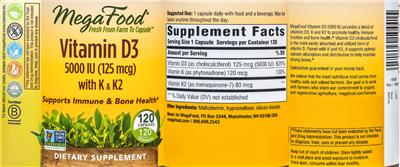
| Vitamin D3 (as Cholecalciferol)5000 IU | 125 mcg | 625% |
| Vitamin K (as Phytonadione) | 120 mcg | 100% |
| Vitamin K2 (as Menaquinone-7) | 80 mcg | † |
Other ingredients: Maltodextrin, Hypromellose, Silicon Dioxide
% Daily Values for: Adults and children 4 or more years of age.
Where this label comes from
An original label of the NIH's Dietary Supplement Label Database, entered there on 22 June 2023, shown here as it was entered. The NIH's record · picture of the label (PDF)
General information
- Product name
- Vitamin D3 5000 IU (125 mcg) with K & K2
- Brand
- MegaFood
- Barcode (UPC)
- 0 51494 10441 5
- Net contents
- 120 Capsule(s)
- Market status
- On market
- DSLD ID
- 287488
Classification
Label statements
Formulation: Does NOT Contain: Tested gluten free Dairy free Soy free Tested 125+ Pesticide & Herbicides Glyphosate Residue Free detoxproject.org
Formulation: Does NOT Contain: Non GMO Project Verified nongmoproject.org
FDA Statement of Identity: Dietary Supplement
Directions: Suggested Use: 1 capsule daily with food and a beverage. May be taken anytime throughout the day.
Formula: Contains: MegaFood Vitamin D3 5000 IU provides a blend of vitamins D3, K and K2 to promote healthy immune function and bone health. Vitamin D3 cholecalciferol is the more easily absorbed and utilized form of vitamin D. Paired with K and K2, it supports optimal calcium absorption to help maintain strong bones.
Precautions: Children: Keep out of reach of children.
Storage: Store in a tightly sealed in a cool place and avoid exposure to moisture.
Directions: Once open, consume within four months.
Brand information
Made for: MegaFood, Manchester, NH, USA
More labels from MegaFood
Labels only: each label is shown as printed on the bottle, with no grades, rankings or advice. A label in this database is not an endorsement of the product. Read the label on the bottle you buy: makers change their formulas. Reverse Age Lab is not affiliated with, or endorsed by, the National Institutes of Health or its Office of Dietary Supplements. The original labels come from the NIH’s public-domain data; the labels since are read by us. Search the Dietary Supplement Label Database.