
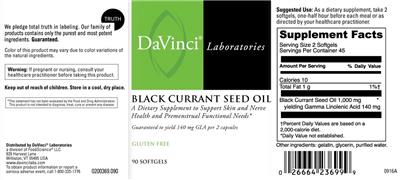
| Calories | 10 | |
| Total Fat | 1 g | 1% |
| Black Currant Seed Oil | 1,000 mg | † |
| Gamma-Linolenic Acid | 140 mg |
Other ingredients: Gelatin, Glycerin, Water, Purified
% Daily Values for: Adults and children 4 or more years of age.
Where this label comes from
An original label of the NIH's Dietary Supplement Label Database, entered there on 18 July 2023, shown here as it was entered. The NIH's record · picture of the label (PDF)
General information
- Product name
- Black Currant Seed Oil
- Brand
- DaVinci Laboratories
- Barcode (UPC)
- 0 26664 23699 9
- Net contents
- 90 Softgel(s)
- Market status
- Off market
- DSLD ID
- 288176
Classification
- Supplement form
- Softgel Capsule
- Product type
- Fat/Fatty Acid
- Claim types on the label
- Nutrient, All Other, Structure/Function
- Intended for
- Adult (18 - 50 Years), Gluten Free
Label statements
Precautions: Pregnant or Nursing or Prescription Medications: Warning: If pregnant or nursing, consult your healthcare practitioner before taking this product.
Precautions: Children: Keep out of reach of children.
Storage: Store in a cool, dry place.
Formula: Contains: Guaranteed to yield 140 mg GLA per 2 capsules
Formulation: Does NOT Contain: Gluten free
FDA Statement of Identity: A Dietary Supplement to support skin and nerve health and premenstrual functional needs
Directions: Suggested use: As a dietary supplement, take 2 softgels, one-half hour before each meal or as directed by your healthcare practitioner.
Precautions: All Other: To obtain product information or report a serious adverse event, call 1-800-325-1776
Brand information
Distributed by: DaVinci Laboratories a division of FoodScience LLC, Williston, VT, USA
More labels from DaVinci Laboratories
Labels only: each label is shown as printed on the bottle, with no grades, rankings or advice. A label in this database is not an endorsement of the product. Read the label on the bottle you buy: makers change their formulas. Reverse Age Lab is not affiliated with, or endorsed by, the National Institutes of Health or its Office of Dietary Supplements. The original labels come from the NIH’s public-domain data; the labels since are read by us. Search the Dietary Supplement Label Database.