
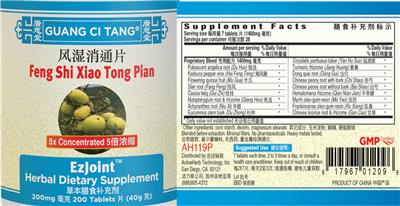
| Proprietary Blend | 1,400 mg | |
| pubescent Angelica | ||
| Kadsura Pepper VineHai Feng Teng | † | |
| Flowering QuinceMu Gua | † | |
| SilerFang Feng | ||
| CassiaGui Zhi | † | |
| Notopterygium (as Notopterygium, Notopterygium) | † | |
| AchyranthesNiu Xi | † | |
| Eucommia (as Eucommia, Eucommia)Du Zhong | † | |
| Corydalis yanhusuoYan Hu Suo | † | |
| TurmericJiang Huang | † | |
| Dong QuaiDang Gui | † | |
| Chinese PeonyChi Shao | † | |
| Chinese PeonyBai Shao | † | |
| HomalomenaQian Nian Jian | † | |
| MyrrhMo Yao | † | |
| FrankincenseRu Xiang | † | |
| Chinese Licorice (as Chinese Licorice, Chinese Licorice) | † |
Other ingredients: Corn Starch, Dextrin, Magnesium Stearate
% Daily Values for: Adults and children 4 or more years of age.
Where this label comes from
An original label of the NIH's Dietary Supplement Label Database, entered there on 14 December 2023, shown here as it was entered. The NIH's record · picture of the label (PDF)
General information
- Product name
- Feng Shi Xiao Tong Pian EzJoint
- Brand
- Guang Ci Tang
- Barcode (UPC)
- 8 17967 01209 6
- Net contents
- 200 Tablet(s); 40 Gram(s)
- Market status
- On market
- DSLD ID
- 288717
Classification
- Supplement form
- Tablet or Pill
- Product type
- Botanical
- Claim types on the label
- All Other
- Intended for
- Adult (18 - 50 Years)
Label statements
FDA Statement of Identity: Herbal Dietary Supplement
Formula: Contains: Minimal fillers.
Formulation: Does NOT Contain: No pharmaceuticals.
Directions: Suggested Use: 7 tablets each time, 2 to 3 times a day, or consult a health care practitioner.
Precautions: Children: Keep out of reach of children.
Brand information
Distributed by: ActiveHerb Technology, Inc., San Diego, CA
More labels from Guang Ci Tang
Labels only: each label is shown as printed on the bottle, with no grades, rankings or advice. A label in this database is not an endorsement of the product. Read the label on the bottle you buy: makers change their formulas. Reverse Age Lab is not affiliated with, or endorsed by, the National Institutes of Health or its Office of Dietary Supplements. The original labels come from the NIH’s public-domain data; the labels since are read by us. Search the Dietary Supplement Label Database.