
glucoZyme
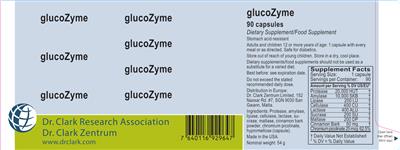
| Protease20,000 HUT | † | |
| Amylase10,000 SKB | † | |
| Lipase200 LU | † | |
| Cellulase400 CU | † | |
| Lactase400 ALU | † | |
| Sucrase200 | † | |
| Maltase200 DP | † | |
| Cinnamon | 50 mg | † |
| Chromium Picolinate | 25 mcg | 62.5% |
Other ingredients: Cinnamon bark powder, Hypromellose
% Daily Values for: Adults and children 4 or more years of age.
Where this label comes from
An original label of the NIH's Dietary Supplement Label Database, entered there on 22 June 2023, shown here as it was entered. The NIH's record · picture of the label (PDF)
General information
- Product name
- glucoZyme
- Brand
- Dr. Clark Research Association Dr. Clark Zentrum
- Barcode (UPC)
- 7 640116 929647
- Net contents
- 90 Capsule(s); 54 Gram(s)
- Market status
- On market
- DSLD ID
- 290183
Classification
- Supplement form
- Capsule
- Product type
- Other Combinations
- Claim types on the label
- All Other
- Intended for
- Children 4 or More Years of Age, Adult (18 - 50 Years)
Label statements
FDA Statement of Identity: Dietary Supplement
Directions: Adults and children 12 or more years of age: 1 capsule with every meal or as directed.
Precautions: Children: Store out of reach of young children.
Storage: Store in a dry, cool place.
Precautions: All Other: Dietary supplement/food supplements should not be used as a substitute for a varied diet. Do not exceed the stated recommended daily dose.
Brand information
Distribution in Europe: Dr. Clark Zentrum Limited, San Gwann, Malta
More labels from Dr. Clark Research Association Dr. Clark Zentrum
Every Dr. Clark Research Association Dr. Clark Zentrum label ›
Labels only: each label is shown as printed on the bottle, with no grades, rankings or advice. A label in this database is not an endorsement of the product. Read the label on the bottle you buy: makers change their formulas. Reverse Age Lab is not affiliated with, or endorsed by, the National Institutes of Health or its Office of Dietary Supplements. The original labels come from the NIH’s public-domain data; the labels since are read by us. Search the Dietary Supplement Label Database.