
TMSport 40,000 Volts! Electrolyte Concentrate
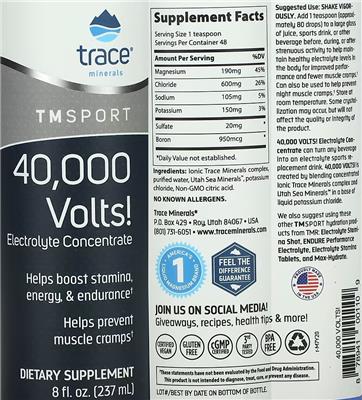
| Magnesium | 190 mg | 45% |
| Chloride | 600 mg | 26% |
| Sodium | 105 mg | 5% |
| Potassium | 150 mg | 3% |
| sulfate | 20 mg | † |
| Boron | 950 mcg | † |
Other ingredients: Ionic Trace Mineral Complex, Water, Purified, Utah Sea Minerals, Potassium Chloride, Citric Acid
% Daily Values for: Adults and children 4 or more years of age.
Where this label comes from
An original label of the NIH's Dietary Supplement Label Database, entered there on 18 July 2023, shown here as it was entered. The NIH's record · picture of the label (PDF)
General information
- Product name
- TMSport 40,000 Volts! Electrolyte Concentrate
- Brand
- Trace Minerals
- Barcode (UPC)
- 8 78941 00110 9
- Net contents
- 8 Fluid Ounce(s); 237 Milliliter(s)
- Market status
- On market
- DSLD ID
- 293811
Classification
Label statements
FDA Statement of Identity: Dietary Supplement
Formulation: Does NOT Contain: No known allergens
Formulation: Does NOT Contain: Gluten free
Directions: Suggested use: Shake vigorously. Add 1 teaspoon (approximately 80 drops) to a large glass of juice, sports drink, or other beverage before, during, or after strenuous activity to help maintain healthy electrolyte levels in the body for improved performance and fewer muscle cramps. Can also be used to help prevent night muscle cramps.
Storage: Store at room temperature.
Formula: Contains: 40,000 Volts! Electrolyte Concentrate can turn any beverage into an electrolyte sports replacement drink. 40,000 Volts! is created by blending concentrated ionic trace minerals complex and Utah sea minerals in a base of liquid potassium chloride.
Brand information
Manufacturer: Trace Minerals, Roy, Utah, USA
More labels from Trace Minerals
Labels only: each label is shown as printed on the bottle, with no grades, rankings or advice. A label in this database is not an endorsement of the product. Read the label on the bottle you buy: makers change their formulas. Reverse Age Lab is not affiliated with, or endorsed by, the National Institutes of Health or its Office of Dietary Supplements. The original labels come from the NIH’s public-domain data; the labels since are read by us. Search the Dietary Supplement Label Database.