
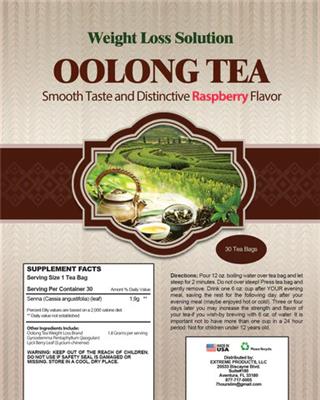
| Senna (as Cassia angustifolia) | 1.9 g | † |
Other ingredients: Oolong Tea, Gynostemma pentaphyllum, Lycii Berry
% Daily Values for: Adults and children 4 or more years of age.
Where this label comes from
An original label of the NIH's Dietary Supplement Label Database, entered there on 18 July 2023, shown here as it was entered. The NIH's record · picture of the label (PDF)
General information
- Product name
- Oolong Tea Raspberry Flavor
- Brand
- Extreme Products
- Barcode (UPC)
- Not printed
- Net contents
- 30 Tea Bag(s)
- Market status
- Off market
- DSLD ID
- 294112
Classification
- Supplement form
- Other (e.g. tea bag)
- Product type
- Botanical
- Claim types on the label
- All Other, Structure/Function
- Intended for
- Children 4 or More Years of Age, Adult (18 - 50 Years)
Label statements
Formula: Contains: Smooth taste and distinctive raspberry flavor
Precautions: Children: Warning: Keep out of the reach of children.
Precautions: All Other: Do not use if safety seal is damaged or missing.
Storage: Store in a cool, dry place.
Directions: Directions: Pour 12 oz. boiling water over tea bag and let steep for 2 minutes. Do not over steep! Press tea bag and gently remove. Drink one 6 oz. cup after your evening meal, saving the rest for the following day after your evening meal (maybe enjoyed hot or cold). Three or four days later you may increase the strength and flavor of your tea - if you wish - by brewing with 6 oz. of water. It is important not to have more than one cup in a 24 hour period.
Precautions: Children: Not for children under 12 years old.
Brand information
Distributed by: Extreme Products, LLC, Aventura, FL
More labels from Extreme Products
Labels only: each label is shown as printed on the bottle, with no grades, rankings or advice. A label in this database is not an endorsement of the product. Read the label on the bottle you buy: makers change their formulas. Reverse Age Lab is not affiliated with, or endorsed by, the National Institutes of Health or its Office of Dietary Supplements. The original labels come from the NIH’s public-domain data; the labels since are read by us. Search the Dietary Supplement Label Database.