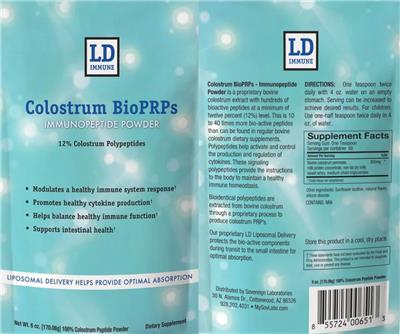
| Bovine Colostrum permeate (as Medium-Chain Triglycerides, Milk Protein concentrate, non-fat dry Milk, Sweet Whey) | 800 mg | † |
Other ingredients: Sunflower Lecithin, Natural flavor, Silicon Dioxide
% Daily Values for: Adults and children 4 or more years of age.
Where this label comes from
An original label of the NIH's Dietary Supplement Label Database, entered there on 22 June 2023, shown here as it was entered. The NIH's record · picture of the label (PDF)
General information
- Product name
- Colostrum BioPRPs
- Brand
- LD Immune
- Barcode (UPC)
- 8 55724 00651 3
- Net contents
- 6 Ounce(s); 170.08 Gram(s)
- Market status
- On market
- DSLD ID
- 295545
Classification
- Supplement form
- Powder
- Product type
- Non-Nutrient/Non-Botanical
- Claim types on the label
- All Other, Structure/Function
- Intended for
- Adult (18 - 50 Years)
Label statements
Formula: Contains: Immunopeptide powder 12% Colostrum polypeptides
FDA Statement of Identity: Dietary Supplement
Formula: Contains: 100% Colostrum peptide powder Colostrum BioPRPs - Immunopeptide powdercapsules a proprietary bovine colostrum extract with hundreds of bioactive peptides at a minimum of twelve percent (12%) level. This is 10 to 40 times more bio-active peptides than can be found in regular bovine colostrum dietary supplements.
Directions: Directions: one teaspoon twice daily with 4 oz. water on empty stomach. Serving can be increased to achieve desired results. For children: Use one-half teaspoon twice daily in 4 oz. of water.
Precautions: Allergies: Contains: Milk
Storage: Store this product in a cool, dry place.
Brand information
Distributed by: Sovereign Laboratories, Cottonwood, AZ
More labels from LD Immune
Labels only: each label is shown as printed on the bottle, with no grades, rankings or advice. A label in this database is not an endorsement of the product. Read the label on the bottle you buy: makers change their formulas. Reverse Age Lab is not affiliated with, or endorsed by, the National Institutes of Health or its Office of Dietary Supplements. The original labels come from the NIH’s public-domain data; the labels since are read by us. Search the Dietary Supplement Label Database.