
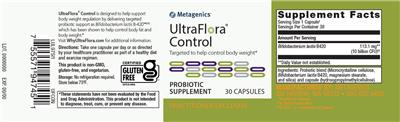
| Bifidobacterium lactis B-42010 Billion CFU. At date of expiration. | 113.1 mg | † |
Other ingredients: Microcrystalline Cellulose, Bifidobacterium lactis B-420, Magnesium Stearate, Silica, Hydroxypropyl Methylcellulose
% Daily Values for: Adults and children 4 or more years of age.
Where this label comes from
An original label of the NIH's Dietary Supplement Label Database, entered there on 23 August 2023, shown here as it was entered. The NIH's record · picture of the label (PDF)
General information
- Product name
- UltraFlora Control
- Brand
- Metagenics
- Barcode (UPC)
- 7 55571 94745 1
- Net contents
- 30 Vegetarian Capsule(s)
- Market status
- On market
- DSLD ID
- 295878
Classification
- Supplement form
- Capsule
- Product type
- Non-Nutrient/Non-Botanical
- Claim types on the label
- All Other, Structure/Function
- Intended for
- Vegetarian, Adult (18 - 50 Years), Gluten Free
Label statements
Formula: Contains: UltraFlora Control is designed to help support body weight regulation by delivering targeted probiotic support as Bifidobacterium lactis B-420 which has been shown to help control body fat and body weight.
Directions: Directions: Take one capsule per day or as directed by your healthcare practitioner as part of a healthy diet and exercise regimen.
Formulation: Does NOT Contain: This product is non-GMO, gluten-free, and vegetarian.
Storage: Storage: No refrigeration required. Store below 75 degrees F.
Formulation: Does NOT Contain: Certified Gluten Free GFCO.org (Gluten-Free Certification Organization)
FDA Statement of Identity: Probiotic Supplement
Precautions: All Other: Practitioner Exclusive
Brand information
Manufactured by: Metagenics, Gig Harbor, WA
More labels from Metagenics
Labels only: each label is shown as printed on the bottle, with no grades, rankings or advice. A label in this database is not an endorsement of the product. Read the label on the bottle you buy: makers change their formulas. Reverse Age Lab is not affiliated with, or endorsed by, the National Institutes of Health or its Office of Dietary Supplements. The original labels come from the NIH’s public-domain data; the labels since are read by us. Search the Dietary Supplement Label Database.