
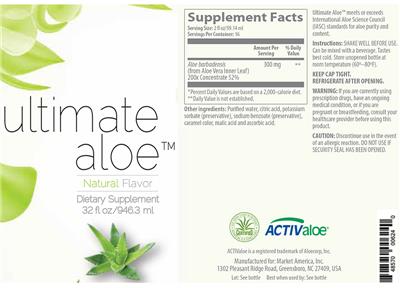
| Aloe barbadensis Concentrate (as Aloe vera)200X Concentrate 52% | 300 mg | † |
Other ingredients: Water, Purified, Citric Acid, Potassium Sorbate, Sodium Benzoate, Caramel color, Malic Acid, Ascorbic Acid
% Daily Values for: Adults and children 4 or more years of age.
Where this label comes from
An original label of the NIH's Dietary Supplement Label Database, entered there on 22 November 2023, shown here as it was entered. The NIH's record · picture of the label (PDF)
General information
- Product name
- Ultimate Aloe Natural Flavor
- Brand
- Market America
- Barcode (UPC)
- 8 48570 00624 0
- Net contents
- 32 Fluid Ounce(s); 946.3 Milliliter(s)
- Market status
- On market
- DSLD ID
- 298806
Classification
Label statements
FDA Statement of Identity: Dietary Supplement
Formula: Contains: Ultimate Aloe meets or exceeds International Aloe Science Council (IASC) standards for aloe purity and content.
Directions: Instructions: Shake well before use. Can be mixed with a beverage. Tastes best cold.
Storage: Store unopened bottle at room temperature (60 degrees - 80 degrees F). Keep cap tight. Refrigerate after opening.
Precautions: Pregnant or Nursing or Prescription Medications: Warning: If you are currently using prescription drugs, have an ongoing medical condition, or if you are pregnant or breastfeeding, consult your healthcare provider before using this product.
Precautions: Allergies: Caution: Discontinue use in the event of an allergic reaction.
Precautions: All Other: Do not use if security seal has been opened.
Formula: Contains: ActivAloe
Brand information
Manufactured for: Market America, Inc., Greensboro, NC, USA
More labels from Market America
Labels only: each label is shown as printed on the bottle, with no grades, rankings or advice. A label in this database is not an endorsement of the product. Read the label on the bottle you buy: makers change their formulas. Reverse Age Lab is not affiliated with, or endorsed by, the National Institutes of Health or its Office of Dietary Supplements. The original labels come from the NIH’s public-domain data; the labels since are read by us. Search the Dietary Supplement Label Database.