
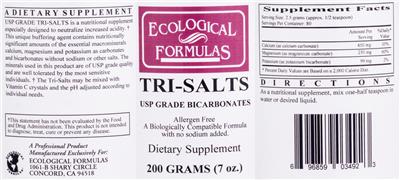
| Calcium (as Calcium Carbonate) | 450 mg | 35% |
| Magnesium (as Magnesium Carbonate) | 250 mg | 60% |
| Potassium (as Potassium Bicarbonate) | 99 mg | 2% |
% Daily Values for: Adults and children 4 or more years of age.
Where this label comes from
An original label of the NIH's Dietary Supplement Label Database, entered there on 22 November 2023, shown here as it was entered. The NIH's record · picture of the label (PDF)
General information
- Product name
- Tri-Salts
- Brand
- Ecological Formulas
- Barcode (UPC)
- 6 96859 03492 3
- Net contents
- 200 Gram(s); 7 Ounce(s)
- Market status
- On market
- DSLD ID
- 299791
Classification
Label statements
Formula: Contains: USP grade TRI-SALTS is a nutritional supplement especially designed to nutritional supplement especially designed to neutralize increased acidity. This unique buffering agent contains nutritionally significant amounts of the essential macrominerals calcium, magnesium and potassium as carbonates and bicarbonates without sodium or other salts. The minerals used in this product are of USP grade quality and are well tolerated by the most sensitive individuals. The Tri-Salts may be mixed with vitamin C crystals and the pH adjusted accordingly to individual needs.
Formula: Contains: USP grade bicarbonates
Formulation: Does NOT Contain: Allergen free
Formulation: Does NOT Contain: A biologically compatible formula with no sodium added.
FDA Statement of Identity: A Dietary Supplement Dietary Supplement
Directions: Directions As a nutritional supplement, mix one-half teaspoon in water or desired liquid.
Brand information
A Professional Product Manufactured Exclusively For: ECOLOGICAL FORMULAS, CONCORD, CA
More labels from Ecological Formulas
Labels only: each label is shown as printed on the bottle, with no grades, rankings or advice. A label in this database is not an endorsement of the product. Read the label on the bottle you buy: makers change their formulas. Reverse Age Lab is not affiliated with, or endorsed by, the National Institutes of Health or its Office of Dietary Supplements. The original labels come from the NIH’s public-domain data; the labels since are read by us. Search the Dietary Supplement Label Database.