
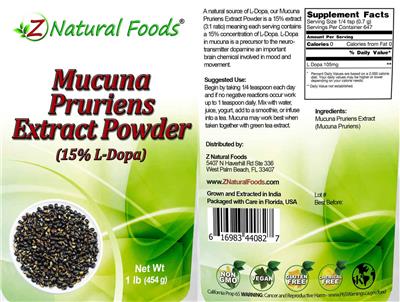
| Calories | 0 | |
| Calories from Fat | 0 | |
| L-Dopa | 105 mg | † |
Other ingredients: Mucuna pruriens Extract, Powder
% Daily Values for: Adults and children 4 or more years of age.
Where this label comes from
An original label of the NIH's Dietary Supplement Label Database, entered there on 14 December 2023, shown here as it was entered. The NIH's record · picture of the label (PDF)
General information
- Product name
- Mucuna Pruriens Extract Powder
- Brand
- Z Natural Foods
- Barcode (UPC)
- 6 16983 44082 7
- Net contents
- 1 Pound(s); 454 Gram(s)
- Market status
- On market
- DSLD ID
- 299860
Classification
- Supplement form
- Powder
- Product type
- Other Combinations
- Claim types on the label
- All Other, Structure/Function
- Intended for
- Vegan, Vegetarian, Adult (18 - 50 Years), Kosher, Gluten Free, Dairy Free
Label statements
Formula: Contains: (15% L-Dopa)
Formula: Contains: A natural source of L-Dopa, our Mucuna Pruriens Extract Powder is a 15% extract (3:1 ratio) meaning each serving contains a 15% concentration of L-Dopa. L-Dopa in mucuna is a precursor to the neurotransmitter dopamine in an important brain chemical involved in mood and movement.
Directions: Suggested use: Begin by taking 1/4 teaspoon each day and if no negative reactions occur work up to 1 teaspoon daily. Mix with water, juice, yogurt, add to a smoothie, or infuse into a tea. Mucuna may work best when taken together with green tea extract.
Formulation: Does NOT Contain: Non GMO Gluten free Chemical free
Precautions: All Other: California Prop 65 Warning: Cancer and Reproductive Harm - www.P65Warnings.ca.gov/food
Brand information
Distributed by: Z Natural Foods, West Palm Beach, FL
More labels from Z Natural Foods
Labels only: each label is shown as printed on the bottle, with no grades, rankings or advice. A label in this database is not an endorsement of the product. Read the label on the bottle you buy: makers change their formulas. Reverse Age Lab is not affiliated with, or endorsed by, the National Institutes of Health or its Office of Dietary Supplements. The original labels come from the NIH’s public-domain data; the labels since are read by us. Search the Dietary Supplement Label Database.