
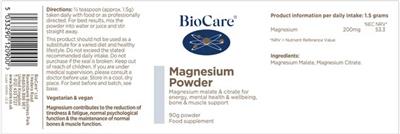
| Magnesium | 200 mg | 53.3% |
Other ingredients: Magnesium Malate, Magnesium Citrate
% Daily Values for: Adults and children 4 or more years of age.
Where this label comes from
An original label of the NIH's Dietary Supplement Label Database, entered there on 24 January 2024, shown here as it was entered. The NIH's record · picture of the label (PDF)
General information
- Product name
- Magnesium Powder
- Brand
- BioCare
- Barcode (UPC)
- 5 033290 120900
- Net contents
- 90 Gram(s)
- Market status
- Off market
- DSLD ID
- 302222
Classification
Label statements
Directions: Directions: 1/2 teaspoon (approx. 1.5 g) taken daily with food or as professionally directed. For best results, mix the powder into water or juice and stir straight away.
Precautions: All Other: This product should not be used as a substitute for a varied diet and healthy lifestyle. Do not exceed the stated recommended daily intake. Do not purchase if seal is broken. If you are under medical supervision, please consult a doctor before use.
Storage: Store in a cool, dry place.
Formula: Contains: Magnesium malate & citrate for energy, mental health & wellbeing, bone & muscle support
FDA Statement of Identity: Food Supplement
Brand information
Manufacturer: BioCare Ltd, Ravensbank Business Park, Redditch, United Kingdom
More labels from BioCare
Labels only: each label is shown as printed on the bottle, with no grades, rankings or advice. A label in this database is not an endorsement of the product. Read the label on the bottle you buy: makers change their formulas. Reverse Age Lab is not affiliated with, or endorsed by, the National Institutes of Health or its Office of Dietary Supplements. The original labels come from the NIH’s public-domain data; the labels since are read by us. Search the Dietary Supplement Label Database.