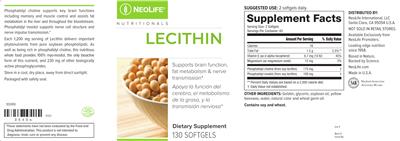
| Calories | 16 | |
| Total Fat | 1.5 g | 2.5% |
| Vitamin E (as D-Alpha-Tocopherol)10 IU | 6.7 mg | 45% |
| Magnesium (as Magnesium Oxide) | 12 mg | 3% |
| Phosphatidyl Choline (as as Soy Lecithin) | 175 mg | † |
| Phosphatidyl Inositol (as from Soy Lecithin) | 100 mg | † |
Other ingredients: Gelatin, Glycerin, Soybean Oil, Yellow Beeswax, Water, Natural color, Wheat Germ Oil
% Daily Values for: Adults and children 4 or more years of age.
Where this label comes from
An original label of the NIH's Dietary Supplement Label Database, entered there on 14 December 2023, shown here as it was entered. The NIH's record · picture of the label (PDF)
General information
- Product name
- Lecithin
- Brand
- NeoLife Nutritionals
- Barcode (UPC)
- 3540s
- Net contents
- 130 Softgel(s)
- Market status
- On market
- DSLD ID
- 303280
Classification
- Supplement form
- Softgel Capsule
- Product type
- Other Combinations
- Claim types on the label
- Nutrient, All Other, Structure/Function
- Intended for
- Adult (18 - 50 Years)
Label statements
Formula: Contains: Each 1,200 mg serving of Lecithin delivers important phytonutrients from pure soybean phospholipids. As well as being rich in phosphatidyl choline, this nutritious whole food provides 100% myo-inositol, the only bioactive form of this nutrient, and 230 mg of other biologically active phosphoglycerides.
Storage: Store in a cool, dry place, away from direct sunlight.
Precautions: All Other: Packaged with safety seal.
FDA Statement of Identity: Dietary Supplement
Directions: Suggested use: 2 softgels daily.
Precautions: Allergies: Contains soy and wheat.
Brand information
Distributed by: NeoLife International, LLC, Santa Clara, CA, U.S.A.
More labels from NeoLife Nutritionals
Labels only: each label is shown as printed on the bottle, with no grades, rankings or advice. A label in this database is not an endorsement of the product. Read the label on the bottle you buy: makers change their formulas. Reverse Age Lab is not affiliated with, or endorsed by, the National Institutes of Health or its Office of Dietary Supplements. The original labels come from the NIH’s public-domain data; the labels since are read by us. Search the Dietary Supplement Label Database.