
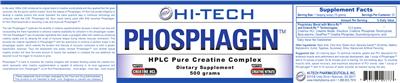
| Proprietary Blend with Micro-Rx and Extend-Rx Technologies | 12.5 g | † |
| Creatine HCl | ||
| Creatine Nitrate | ||
| Disodium Creatine Phosphate Tetrahydrate | ||
| Beta-Alanine | ||
| CreaPhos(TM) Creatine Phosphate | ||
| Guanidinopropionic acid |
Other ingredients: Malic Acid, Citric Acid, Stearic Acid, Naturally Sweet(TM), Silica, Natural and Artificial flavoring
% Daily Values for: Adults and children 4 or more years of age.
Where this label comes from
An original label of the NIH's Dietary Supplement Label Database, entered there on 26 February 2014, shown here as it was entered. The NIH's record
General information
- Product name
- Phosphagen
- Brand
- Hi-Tech Pharmaceuticals
- Barcode (UPC)
- 8 53598 00376 8
- Net contents
- 500 Gram(s)
- Market status
- On market
- DSLD ID
- 30417
Classification
- Supplement form
- Powder
- Product type
- Other Combinations
- Claim types on the label
- All Other, Structure/Function
- Intended for
- Adult (18 - 50 Years)
Label statements
FDA Statement of Identity: Dietary Supplement
Directions: Suggested Use: On training days: To optimize creatine uptake and PCr deposition for enhanced muscle work performance and muscular development, take 1 scoop of Phosphagen(TM) with 8-10 ounces of water 20-30 minutes prior to training. On non-training days: To volumize muscle cells, speed recovery, and maximize saturation of PCr stores, take 1 scoop of Phosphagen(TM) with 8-10 ounces of water anytime as desired during the day.
Formula: Contains: WITH CREATINE HCL
Formula: Contains: WITH CREATINE NITRATE
Brand information
Other: Hi-Tech Pharmaceuticals, Inc., Norcross, GA
More labels from Hi-Tech Pharmaceuticals
Labels only: each label is shown as printed on the bottle, with no grades, rankings or advice. A label in this database is not an endorsement of the product. Read the label on the bottle you buy: makers change their formulas. Reverse Age Lab is not affiliated with, or endorsed by, the National Institutes of Health or its Office of Dietary Supplements. The original labels come from the NIH’s public-domain data; the labels since are read by us. Search the Dietary Supplement Label Database.