
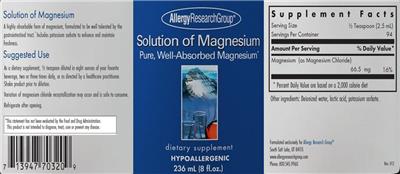
| Magnesium (as Magnesium Chloride) | 66.5 mg | 16% |
Other ingredients: Water, Deionized, Lactic Acid, Potassium Sorbate
% Daily Values for: Adults and children 4 or more years of age.
Where this label comes from
An original label of the NIH's Dietary Supplement Label Database, entered there on 22 March 2024, shown here as it was entered. The NIH's record · picture of the label (PDF)
General information
- Product name
- Solution of Magnesium
- Brand
- Allergy Research Group
- Barcode (UPC)
- 7 13947 70320 9
- Net contents
- 236 mL; 8 Fluid Ounce(s)
- Market status
- On market
- DSLD ID
- 304276
Classification
Label statements
Formula: Contains: A highly absorbable form of magnesium, formulated to be well tolerated by the gastrointestinal tract. Includes potassium sorbate to enhance and maintain freshness.
Directions: Suggested use As a dietary supplement, 1/2 teaspoon diluted in eight ounces of your favorite beverage, two or three times daily, or as directed by a healthcare practitioner. Shake product prior to dilution.
Storage: Refrigerate after opening.
Formula: Contains: Pure, well-absorbed magnesium
FDA Statement of Identity: Dietary Supplement.
Brand information
Formulated exclusively for: Allergy Research Group, South Salt Lake, UT
More labels from Allergy Research Group
Labels only: each label is shown as printed on the bottle, with no grades, rankings or advice. A label in this database is not an endorsement of the product. Read the label on the bottle you buy: makers change their formulas. Reverse Age Lab is not affiliated with, or endorsed by, the National Institutes of Health or its Office of Dietary Supplements. The original labels come from the NIH’s public-domain data; the labels since are read by us. Search the Dietary Supplement Label Database.