
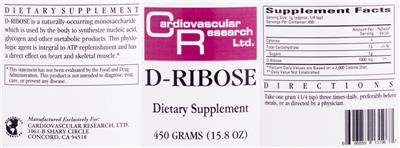
| Calories | 4 | |
| Total Carbohydrate | 1 g | <1% |
| Sugars | 1 g | |
| D-Ribose | 1,000 mg | † |
% Daily Values for: Adults and children 4 or more years of age.
Where this label comes from
An original label of the NIH's Dietary Supplement Label Database, entered there on 22 March 2024, shown here as it was entered. The NIH's record · picture of the label (PDF)
General information
- Product name
- D-Ribose
- Brand
- Cardiovascular Research
- Barcode (UPC)
- 6 96859 13196 7
- Net contents
- 450 Gram(s); 15.8 Ounce(s)
- Market status
- On market
- DSLD ID
- 304376
Classification
- Supplement form
- Powder
- Product type
- Fiber and Other Nutrients
- Claim types on the label
- Nutrient, All Other, Structure/Function
- Intended for
- Adult (18 - 50 Years)
Label statements
FDA Statement of Identity: Dietary Supplement
Formula: Contains: D-Ribose is a naturally-occurring monosaccharide which is used by the body to synthesize nucleic acid, glycogen and other metabolic products. This physiologic agent is integral to ATP replenishment and has a direct effect on heart and skeletal muscle.
Directions: Directions Take one gram (1/4 tsp) three times daily, preferably before meals, or as directed by a physician.
Brand information
Manufactured exclusively for: Cardiovascular Research, Ltd., Concord, CA
More labels from Cardiovascular Research
Labels only: each label is shown as printed on the bottle, with no grades, rankings or advice. A label in this database is not an endorsement of the product. Read the label on the bottle you buy: makers change their formulas. Reverse Age Lab is not affiliated with, or endorsed by, the National Institutes of Health or its Office of Dietary Supplements. The original labels come from the NIH’s public-domain data; the labels since are read by us. Search the Dietary Supplement Label Database.