
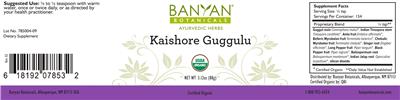
| Proprietary Blend | 0.25 Teaspoon | † |
| Guggulcertified organic | ||
| Indian Tinosporacertified organic | ||
| Amlacertified organic | ||
| Belleric Myrobalancertified organic | ||
| Chebulic Myrobalancertified organic | ||
| Gingercertified organic | ||
| Long Peppercertified organic | ||
| Black Peppercertified organic | ||
| Baliospermumcertified organic | ||
| Indian Jalapcertified organic | ||
| Silicon Dioxide |
% Daily Values for: Adults and children 4 or more years of age.
Where this label comes from
An original label of the NIH's Dietary Supplement Label Database, entered there on 22 March 2024, shown here as it was entered. The NIH's record · picture of the label (PDF)
General information
- Product name
- Kaishore Guggulu
- Brand
- Banyan Botanicals
- Barcode (UPC)
- 6 18192 07853 2
- Net contents
- 3.12 Ounce(s); 88 Gram(s)
- Market status
- On market
- DSLD ID
- 305689
Classification
- Supplement form
- Other (e.g. tea bag)
- Product type
- Botanical with Nutrients
- Claim types on the label
- All Other
- Intended for
- Adult (18 - 50 Years), Organic
Label statements
Directions: Suggested use: 1/8 to 1/4 teaspoon with warm water, once or twice daily, or as directed by your health practitioner.
FDA Statement of Identity: Dietary Supplement
Formula: Contains: Ayurvedic herbs
Brand information
Distributed by: Banyan Botanicals, Albuquerque, NM
More labels from Banyan Botanicals
Labels only: each label is shown as printed on the bottle, with no grades, rankings or advice. A label in this database is not an endorsement of the product. Read the label on the bottle you buy: makers change their formulas. Reverse Age Lab is not affiliated with, or endorsed by, the National Institutes of Health or its Office of Dietary Supplements. The original labels come from the NIH’s public-domain data; the labels since are read by us. Search the Dietary Supplement Label Database.