
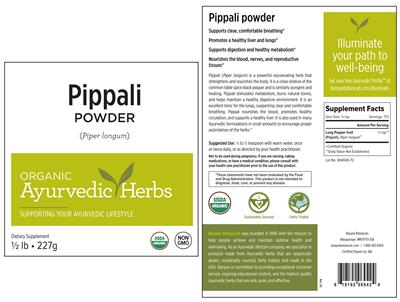
| Long Peppercertified organic | 0.5 Teaspoon | † |
% Daily Values for: Adults and children 4 or more years of age.
Where this label comes from
An original label of the NIH's Dietary Supplement Label Database, entered there on 23 April 2024, shown here as it was entered. The NIH's record · picture of the label (PDF)
General information
- Product name
- Pippali Powder
- Brand
- Banyan Botanicals
- Barcode (UPC)
- 6 18192 06942 4
- Net contents
- 0.5 Pound(s); 227 Gram(s)
- Market status
- On market
- DSLD ID
- 305716
Classification
Label statements
Formula: Contains: Pippali Powder (Piper longum) Organic ayurvedic herbs
FDA Statement of Identity: Dietary Supplement
Formulation: Does NOT Contain: Non GMO
Formula: Contains: Pippali (Piper longum) is a powerful rejuvenating herb that strengthens and nourishes the body. It is a close relative of the common table spice black pepper and is similarly pungent and heating. Pippali stimulate metabolism, burns natural toxins, and helps maintain a healthy digestive environment. It is an excellent tonic for the lungs, supporting clear and comfortable breathing. Pippali nourishes the blood, promotes healthy circulation and supports a healthy liver. It is also used in many Ayurvedic formulations in small amounts to encourage proper assimilation of the herbs.
Directions: Suggested use: 1/4 to 1/2 teaspoon with warm water, once or twice daily, or as directed by your health practitioner.
Precautions: Pregnant or Nursing or Prescription Medications: Not to be used during pregnancy. If you are nursing, taking medications, or have a medical condition, please consult with your health care practitioner prior to the use of this product.
Brand information
Manufacturer: Banyan Botanicals, Albuquerque, NM, USA
More labels from Banyan Botanicals
Labels only: each label is shown as printed on the bottle, with no grades, rankings or advice. A label in this database is not an endorsement of the product. Read the label on the bottle you buy: makers change their formulas. Reverse Age Lab is not affiliated with, or endorsed by, the National Institutes of Health or its Office of Dietary Supplements. The original labels come from the NIH’s public-domain data; the labels since are read by us. Search the Dietary Supplement Label Database.