
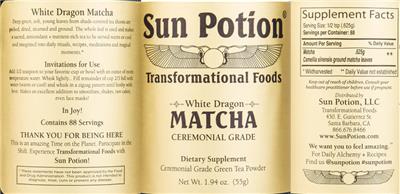
| Matcha (as Camellia sinensis)Ground matcha, wildharvested | 0.63 g | † |
% Daily Values for: Adults and children 4 or more years of age.
Where this label comes from
An original label of the NIH's Dietary Supplement Label Database, entered there on 22 March 2024, shown here as it was entered. The NIH's record · picture of the label (PDF)
General information
- Product name
- White Dragon Matcha
- Brand
- Sun Potion
- Barcode (UPC)
- 8 50001 14611 1
- Net contents
- 1.94 Ounce(s); 55 Gram(s)
- Market status
- On market
- DSLD ID
- 308002
Classification
Label statements
Directions: Invitations for use Add 1/2 teaspoon to your favorite cup or bowl with an ounce of room temperature water. Whisk lightly... Fill remainder of cup 2/3 full with water (warm or cool) and whisk in a zigzag pattern until frothy with love. Makes an excellent addition to smoothies, shakes, raw cakes, even face masks! In joy!
FDA Statement of Identity: Dietary Supplement
Formula: Contains: Ceremonial grade green tea powder
Precautions: Children: Keep out of reach of children.
Precautions: Pregnant or Nursing or Prescription Medications: Consult your healthcare practitioner before use if pregnant.
Brand information
Distributed by: Sun Potion, LLC Transformational Foods, Santa Barbara, CA
More labels from Sun Potion
Labels only: each label is shown as printed on the bottle, with no grades, rankings or advice. A label in this database is not an endorsement of the product. Read the label on the bottle you buy: makers change their formulas. Reverse Age Lab is not affiliated with, or endorsed by, the National Institutes of Health or its Office of Dietary Supplements. The original labels come from the NIH’s public-domain data; the labels since are read by us. Search the Dietary Supplement Label Database.