
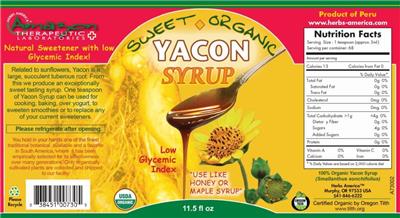
| Calories | 13 | |
| Calories from Fat | 0 | |
| Total Fat | 0 g | 0% |
| Saturated Fat | 0 g | 0% |
| Trans Fat | 0 g | 0% |
| Cholesterol | 0 mg | 0% |
| Sodium | 0 mg | 0% |
| Total Carbohydratesgreater than 1 g | <4 g | 0% |
| Dietary Fiber | 0 g | 0% |
| Sugar | 4 g | 0% |
| Added Sugars | 0 g | 0% |
| Protein | 0 g | 0% |
| Vitamin A | 0% | |
| Calcium | 0% | |
| Vitamin C | 0% | |
| Iron | 0% | |
| Yacon Syrup100% organic |
% Daily Values for: Adults and children 4 or more years of age.
Where this label comes from
An original label of the NIH's Dietary Supplement Label Database, entered there on 23 May 2024, shown here as it was entered. The NIH's record · picture of the label (PDF)
General information
- Product name
- Yacon Syrup
- Brand
- Amazon Therapeutics
- Barcode (UPC)
- 8 38451 00730 5
- Net contents
- 11.5 Fluid Ounce(s)
- Market status
- On market
- DSLD ID
- 308023
Classification
Label statements
Formula: Contains: Natural sweetener with low Glycemic Index! Related to sunflowers, Yacon is a large, succulent tuberous root. From this we produce an exceptionally sweet tasting syrup.
Directions: One teaspoon of Yacon Syrup can be used for cooking, baking, over yogurt, to sweeten smoothies or to replace any of your current sweeteners.
Storage: Please refrigerate after opening.
Directions: "Use like honey or maple syrup"
Brand information
Manufacturer: Herbs America, Murphy, OR
More labels from Amazon Therapeutics
Labels only: each label is shown as printed on the bottle, with no grades, rankings or advice. A label in this database is not an endorsement of the product. Read the label on the bottle you buy: makers change their formulas. Reverse Age Lab is not affiliated with, or endorsed by, the National Institutes of Health or its Office of Dietary Supplements. The original labels come from the NIH’s public-domain data; the labels since are read by us. Search the Dietary Supplement Label Database.