
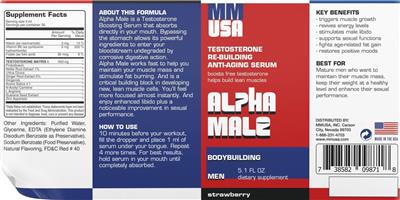
| Niacin (as Niacinamide) | 3 mg | 15% |
| Vitamin B6 (as Pyridoxine Hydrochloride) | 5 mg | 250% |
| Folate (as Folic Acid) | 30 mcg | 8% |
| Testosterone Matrix I | 1,600 mg | † |
| Protodioscin | † | |
| Nettle Root Extract1% | † | |
| Urtica dioica | † | |
| Ginger Root Extract5% | † | |
| Gingerols | † | |
| Avena sativa4:1 | † | |
| N-Acetyl Carnitine | † | |
| L-Arginine | † | |
| Guarana Seed Extract | † | |
| Zinc Aspartate | † |
Other ingredients: Water, Purified, Glycerin, EDTA, Sodium Benzoate, Natural Flavors, FD&C Red #40
% Daily Values for: Adults and children 4 or more years of age.
Where this label comes from
An original label of the NIH's Dietary Supplement Label Database, entered there on 23 May 2024, shown here as it was entered. The NIH's record · picture of the label (PDF)
General information
- Product name
- Alpha Male Strawberry
- Brand
- MMUSA
- Barcode (UPC)
- 7 38582 09871 8
- Net contents
- 5.1 Fluid Ounce(s)
- Market status
- On market
- DSLD ID
- 308314
Classification
- Supplement form
- Liquid
- Product type
- Other Combinations
- Claim types on the label
- All Other, Structure/Function
- Intended for
- Adult Male (18-50 Years), Seniors/Mature (>50 Years) - Men ONLY
Label statements
Directions: How to use 10 minutes before your workout, fill the dropper and place 1 mL of serum under your tongue. Repeat 4 more times. For best results, hold serum in your mouth until completely absorbed.
FDA Statement of Identity: Dietary Supplement
Brand information
Distributed by: MMUSA, Inc., Carson City, Nevada
More labels from MMUSA
Labels only: each label is shown as printed on the bottle, with no grades, rankings or advice. A label in this database is not an endorsement of the product. Read the label on the bottle you buy: makers change their formulas. Reverse Age Lab is not affiliated with, or endorsed by, the National Institutes of Health or its Office of Dietary Supplements. The original labels come from the NIH’s public-domain data; the labels since are read by us. Search the Dietary Supplement Label Database.