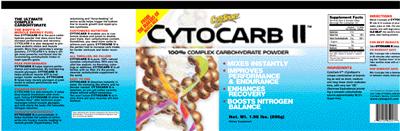
| Calories | 210 {Calories} | |
| Total Fat | 0 g | 0% |
| Total Carbohydrates | 53 g | 18% |
| Sugar | 2 g | |
| Protein | 0 g | |
| Sodium | 45 mg | 2% |
Other ingredients: CytoCarb II(TM)
% Daily Values for: Adults and children 4 or more years of age.
Where this label comes from
An original label of the NIH's Dietary Supplement Label Database, entered there on 26 February 2014, shown here as it was entered. The NIH's record
General information
- Product name
- Cytocarb II
- Brand
- CytoSport
- Barcode (UPC)
- 6 60726 82001 8
- Net contents
- 1.98 lbs; 896 Gram(s)
- Market status
- On market
- DSLD ID
- 30870
Classification
- Supplement form
- Powder
- Product type
- Other Combinations
- Claim types on the label
- Structure/Function
- Intended for
- Adult (18 - 50 Years)
Label statements
FDA Statement of Identity: Dietary Supplement
Directions: Blend 4 scoops of CYTOCA II into 8-12 ounces of your water, juice or milk. For even results, mix with legendary CLE MILK(R), the world’s most plete, best tasting protein. FOR BEST RESULTS Take CYTOCARB II twice p ON WORKOUT DAYS Mix 4 scoops into a beverage in 60 minutes after workouts ing the “Golden Hour” of rec Take another dose with or be meals. NON WORKOUT DAYS Mix 4 scoops into a beverage or between meals, twice per
Formulation: Does NOT Contain: With zero fat, ultra low sodium, no flavoring, colorings or additives, CYTOCARB II is all thriller, with no filler.
Brand information
Manufacturer: CytoSport, Benicia, CA
More labels from CytoSport
Labels only: each label is shown as printed on the bottle, with no grades, rankings or advice. A label in this database is not an endorsement of the product. Read the label on the bottle you buy: makers change their formulas. Reverse Age Lab is not affiliated with, or endorsed by, the National Institutes of Health or its Office of Dietary Supplements. The original labels come from the NIH’s public-domain data; the labels since are read by us. Search the Dietary Supplement Label Database.