
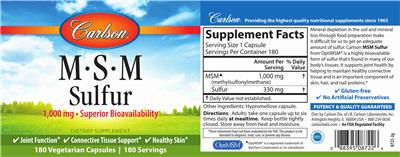
| OptiMSM (as Methylsulfonylmethane)OptiMSM is a registered trademark of Balchem Corporation or its subsidiaries | 1,000 mg | † |
| Sulfur | 330 mg | † |
Other ingredients: Hypromellose
% Daily Values for: Adults and children 4 or more years of age.
Where this label comes from
An original label of the NIH's Dietary Supplement Label Database, entered there on 22 February 2024, shown here as it was entered. The NIH's record · picture of the label (PDF)
General information
- Product name
- M-S-M Sulfur 1,000 mg
- Brand
- Carlson
- Barcode (UPC)
- 0 88395 08722 6
- Net contents
- 180 Vegetarian Capsule(s)
- Market status
- On market
- DSLD ID
- 309237
Classification
- Supplement form
- Capsule
- Product type
- Other Combinations
- Claim types on the label
- Nutrient, All Other, Structure/Function
- Intended for
- Adult (18 - 50 Years), Gluten Free
Label statements
FDA Statement of Identity: Dietary Supplement
Directions: Directions: Adults: Take one capsule up to six times daily at mealtime.
Storage: Keep bottle tightly closed. Store away from heat and moisture.
Formula: Contains: Mineral depletion in the soil and mineral loss through food preparation make it difficult for us to get an adequate amount of sulfur. Carlson MSM Sulfur from OptiMSM is a highly bioavailable form of sulfur that's found in many of our body's tissues. It supports joint health by helping to maintain healthy connective tissue and is an important component of skin, hair, and nail proteins.
Formulation: Does NOT Contain: Gluten-free No artificial preservatives
Brand information
Distributed by: Carlson Div. of J.R. Carlson Laboratories, Inc., Arlington Heights, IL, USA
More labels from Carlson
Labels only: each label is shown as printed on the bottle, with no grades, rankings or advice. A label in this database is not an endorsement of the product. Read the label on the bottle you buy: makers change their formulas. Reverse Age Lab is not affiliated with, or endorsed by, the National Institutes of Health or its Office of Dietary Supplements. The original labels come from the NIH’s public-domain data; the labels since are read by us. Search the Dietary Supplement Label Database.