
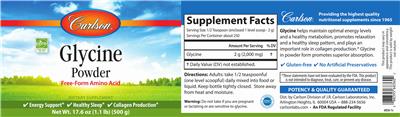
| Glycine2,000 mg | 2 g | † |
% Daily Values for: Adults and children 4 or more years of age.
Where this label comes from
An original label of the NIH's Dietary Supplement Label Database, entered there on 22 March 2024, shown here as it was entered. The NIH's record · picture of the label (PDF)
General information
- Product name
- Glycine Powder
- Brand
- Carlson
- Barcode (UPC)
- 0 88395 68360 2
- Net contents
- 17.6 Ounce(s); 1.1 lb(s); 500 Gram(s)
- Market status
- On market
- DSLD ID
- 309283
Classification
- Supplement form
- Powder
- Product type
- Amino acid/Protein
- Claim types on the label
- Nutrient, All Other, Structure/Function
- Intended for
- Adult (18 - 50 Years), Women (not pregnant or lactating), Gluten Free
Label statements
Formula: Contains: Free-form amino acid
FDA Statement of Identity: Dietary Supplement
Directions: Directions: Adults: Take 1/2 teaspoonful (one level scoopful) daily mixed into food or liquid.
Storage: Keep bottle tightly closed. Store away from heat and moisture.
Precautions: Pregnant or Nursing or Prescription Medications: Warning: Do not take if you are pregnant or lactating or are sensitive to glycine.
Formula: Contains: Glycine helps maintain optimal energy levels and a healthy metabolism, promotes relaxation and a healthy sleep pattern, and plays an important role in collagen production. Glycine in powder form promotes superior absorption.
Formulation: Does NOT Contain: Gluten-free No artificial preservatives
Formulation: Does NOT Contain: IGEN Non-GMO tested
Storage: This product is sold by weight not volume.
Brand information
Distributed by: Carlson Division of J.R. Carlson Laboratories, Inc., Arlington Heights, IL, USA
More labels from Carlson
Labels only: each label is shown as printed on the bottle, with no grades, rankings or advice. A label in this database is not an endorsement of the product. Read the label on the bottle you buy: makers change their formulas. Reverse Age Lab is not affiliated with, or endorsed by, the National Institutes of Health or its Office of Dietary Supplements. The original labels come from the NIH’s public-domain data; the labels since are read by us. Search the Dietary Supplement Label Database.