
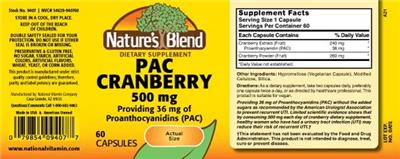
| Cranberry fruit extract | 240 mg | † |
| Proanthocyanidins | 36 mg | † |
| Cranberry, Powder | 260 mg | † |
Other ingredients: Hypromellose, Modified Cellulose, Silica
% Daily Values for: Adults and children 4 or more years of age.
Where this label comes from
An original label of the NIH's Dietary Supplement Label Database, entered there on 23 May 2024, shown here as it was entered. The NIH's record · picture of the label (PDF)
General information
- Product name
- PAC Crandberry 500 mg
- Brand
- Nature's Blend
- Barcode (UPC)
- 0 79854 09407 7
- Net contents
- 60 Capsule(s)
- Market status
- On market
- DSLD ID
- 310417
Classification
Label statements
Storage: Store in a cool, dry place.
Precautions: Children: Keep out of the reach of children.
Precautions: All Other: Double safety sealed for your protection. Do not use if either seal is broken or missing.
Formulation: Does NOT Contain: Preservative & gluten free. No sugar, starch, artificial colors, artificial flavors, wheat, yeast, or corn added.
FDA Statement of Identity: Dietary Supplement
Formula: Contains: Providing 36 mg of Proanthocyanidins (PAC)
Directions: Directions: As a dietary supplement, take two capsules daily, preferably one capsule twice a day, or as directed by healthcare professional.
Formula: Contains: Providing 36 mg of Proanthocyanidins (PAC) without the added sugars as recommended by the American Urologist Association to prevent recurrent U.T.I. Limited scientific evidence shows that by consuming 500 mg each day of cranberry dietary supplement, healthy women who have had a urinary tract infection (UTI) may reduce their risk of recurrent U.T.I.
Brand information
Manufactured by: National Vitamin Company, Casa Grande, AZ
More labels from Nature's Blend
Labels only: each label is shown as printed on the bottle, with no grades, rankings or advice. A label in this database is not an endorsement of the product. Read the label on the bottle you buy: makers change their formulas. Reverse Age Lab is not affiliated with, or endorsed by, the National Institutes of Health or its Office of Dietary Supplements. The original labels come from the NIH’s public-domain data; the labels since are read by us. Search the Dietary Supplement Label Database.