
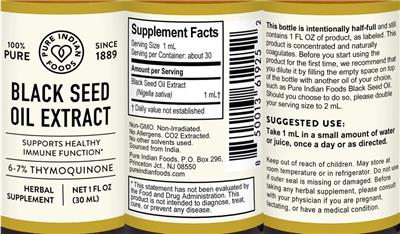
| Black Seed Oil extract | 1 mL | † |
% Daily Values for: Adults and children 4 or more years of age.
Where this label comes from
An original label of the NIH's Dietary Supplement Label Database, entered there on 20 June 2024, shown here as it was entered. The NIH's record · picture of the label (PDF)
General information
- Product name
- Black Seed Oil Extract
- Brand
- Pure Indian Foods
- Barcode (UPC)
- 8 50013 61925 2
- Net contents
- 1 Fluid Ounce(s); 30 mL
- Market status
- On market
- DSLD ID
- 312780
Classification
Label statements
Formula: Contains: 6-7% Thymoquinone
FDA Statement of Identity: Herbal Supplement
Formulation: Does NOT Contain: Non-GMO. Non-irradiated. No allergens. CO2 extracted. No other solvents used.
Directions: This bottle is intentionally half-full and still contains 1 fl oz of product, as labeled. This product is concentrated and naturally coagulates. Before you start using the product for the first time, we recommend that you dilute it by filling the empty space on top of the bottle with another oil of your choice, such as Pure Indian Foods Black Seed Oil. Should you choose to do so, please double your serving size to 2 mL. Suggested use: Take 1 mL in a small amount of water or juice, once a day or as directed.
Precautions: Children: Keep out of reach of children.
Storage: May store at room temperature or in refrigerator.
Precautions: All Other: Do not use if outer seal is missing or damaged.
Precautions: Pregnant or Nursing or Prescription Medications: Before taking any herbal supplement, please consult with your physician if you are pregnant, lactating, or have a medical condition.
Brand information
Manufacturer: Pure Indian Foods, Princeton Jct, NJ
More labels from Pure Indian Foods
Labels only: each label is shown as printed on the bottle, with no grades, rankings or advice. A label in this database is not an endorsement of the product. Read the label on the bottle you buy: makers change their formulas. Reverse Age Lab is not affiliated with, or endorsed by, the National Institutes of Health or its Office of Dietary Supplements. The original labels come from the NIH’s public-domain data; the labels since are read by us. Search the Dietary Supplement Label Database.