
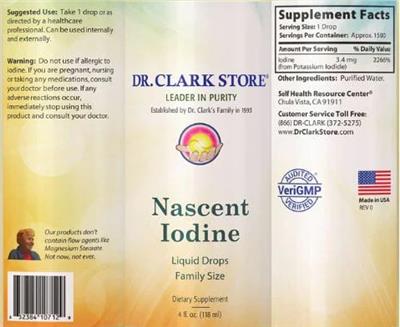
| Iodide (as Potassium Iodide) | 3.4 mg | 2,265% |
Other ingredients: Water, Purified
% Daily Values for: Adults and children 4 or more years of age.
Where this label comes from
An original label of the NIH's Dietary Supplement Label Database, entered there on 25 September 2024, shown here as it was entered. The NIH's record · picture of the label (PDF)
General information
- Product name
- Nascent Iodine
- Brand
- Dr. Clark Store
- Barcode (UPC)
- 6 52384 10712 9
- Net contents
- 4 Fluid Ounce(s); 118 mL
- Market status
- On market
- DSLD ID
- 313176
Classification
Label statements
Directions: Suggested Use: Take 1 drop or as directed by a healthcare professional. Can be used internally and externally.
Precautions: Allergies: Warning: Do not use if allergic to iodine.
Precautions: Pregnant or Nursing or Prescription Medications: If you are pregnant, nursing or taking any medications, consult your doctor before use.
Formulation: Does NOT Contain: Our products don't contain flow agents like Magnesium Stearate. Not now, not ever.
Precautions: All Other: If any adverse reactions occur, immediately stop using this product and consult your doctor.
FDA Statement of Identity: Dietary Supplement
Brand information
Manufacturer: Self Health Resource Center, Chula Vista, CA
More labels from Dr. Clark Store
Labels only: each label is shown as printed on the bottle, with no grades, rankings or advice. A label in this database is not an endorsement of the product. Read the label on the bottle you buy: makers change their formulas. Reverse Age Lab is not affiliated with, or endorsed by, the National Institutes of Health or its Office of Dietary Supplements. The original labels come from the NIH’s public-domain data; the labels since are read by us. Search the Dietary Supplement Label Database.