
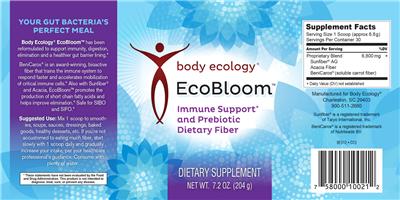
| Proprietary Blend | 6,800 mg | † |
| Sunfiber AG | ||
| Acacia Fiber | ||
| BeniCaros (as Carrot Fiber)soluble carrot fiber |
% Daily Values for: Adults and children 4 or more years of age.
Where this label comes from
An original label of the NIH's Dietary Supplement Label Database, entered there on 25 July 2024, shown here as it was entered. The NIH's record · picture of the label (PDF)
General information
- Product name
- EcoBloom
- Brand
- Body Ecology
- Barcode (UPC)
- 7 58000 10021 2
- Net contents
- 7.2 Ounce(s); 204 Gram(s)
- Market status
- On market
- DSLD ID
- 314767
Classification
- Supplement form
- Powder
- Product type
- Fiber and Other Nutrients
- Claim types on the label
- Nutrient, All Other, Structure/Function
- Intended for
- Adult (18 - 50 Years)
Label statements
Formula: Contains: Body Ecology EcoBloom has been reformulated to support immunity, digestion, elimination and a healthier gut barrier lining. BeniCaros is an award-winning, bioactive fiber that trains the immune system to respond faster and accelerates mobilization of critical immune cells. Also with Sunfiber and Acacia, EcoBloom promotes the production of short chain fatty acids and helps improve elimination. Safe for SIBO and SIFO.
Directions: Suggested Use: Mix 1 scoop to smoothies, soups, sauces, dressings, baked goods, healthy desserts, etc. If you're not accustomed to eating much fiber, start slowly with 1 scoop daily and gradually increase your intake, per your healthcare professional's guidance. Consume with plenty of water.
Formula: Contains: Immune support and Prebiotic Dietary Fiber
FDA Statement of Identity: Dietary Supplement
Brand information
Manufactured for: Body Ecology, Charleston, SC
More labels from Body Ecology
Labels only: each label is shown as printed on the bottle, with no grades, rankings or advice. A label in this database is not an endorsement of the product. Read the label on the bottle you buy: makers change their formulas. Reverse Age Lab is not affiliated with, or endorsed by, the National Institutes of Health or its Office of Dietary Supplements. The original labels come from the NIH’s public-domain data; the labels since are read by us. Search the Dietary Supplement Label Database.