
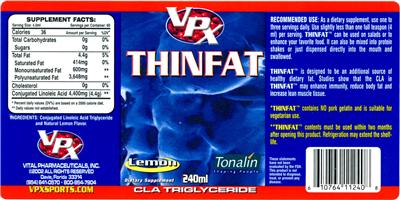
| Calories | 36 {Calories} | |
| Total Carbohydrates | 0 g | 0% |
| Sugar | 0 g | 0% |
| Total Fat | 4.4 g | 5% |
| Saturated Fat | 414 mg | 0% |
| Monounsaturated Fat | 600 mg | † |
| Polyunsaturated Fat | 3,648 mg | † |
| Cholesterol | 0 g | 0% |
| Conjugated Linoleic AcidConjugated Linoleic Acid Note: 4.4g | 4,400 mg | † |
Other ingredients: Ingredients
% Daily Values for: Adults and children 4 or more years of age.
Where this label comes from
An original label of the NIH's Dietary Supplement Label Database, entered there on 23 December 2011, shown here as it was entered. The NIH's record
General information
- Product name
- Thinfat Lemon
- Brand
- VPX
- Barcode (UPC)
- 6 10764 11240 8
- Net contents
- 240 mL
- Market status
- On market
- DSLD ID
- 3154
Classification
- Supplement form
- Liquid
- Product type
- Fat/Fatty Acid
- Claim types on the label
- All Other, Structure/Function
- Intended for
- Vegetarian, Adult (18 - 50 Years)
Label statements
FDA Statement of Identity: Dietary Supplement
Formula: Contains: CLA Triglyceride
Directions: Recommended Use: As a dietary supplement, use one to three servings daily. Use slightly less than one full teaspoon (4 ml) per serving. Thinfat can be used in salads or to enhance your favorite food. It can also be mixed into protein shakes or just dispensed directly into the mouth and swallowed.
Formulation: Does NOT Contain: Thinfat contains no pork gelatin and is suitable for vegetarian use.
Directions: Thinfat contents must be used within two months after opening this product.
Storage: Refrigeration may extend the shelf-life.
Brand information
Manufacturer: Vital Pharmaceuticals, Inc., Davie, Florida
More labels from VPX
Labels only: each label is shown as printed on the bottle, with no grades, rankings or advice. A label in this database is not an endorsement of the product. Read the label on the bottle you buy: makers change their formulas. Reverse Age Lab is not affiliated with, or endorsed by, the National Institutes of Health or its Office of Dietary Supplements. The original labels come from the NIH’s public-domain data; the labels since are read by us. Search the Dietary Supplement Label Database.