
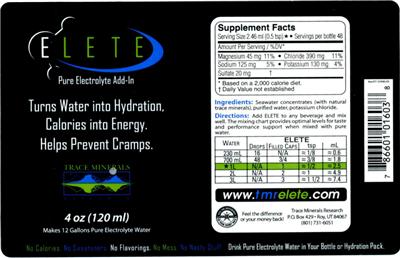
| Magnesium | 45 mg | 11% |
| Sodium | 125 mg | 5% |
| Sulfate | 20 mg | † |
| Chloride | 390 mg | 11% |
| Potassium | 130 mg | 4% |
Other ingredients: Ingredients
% Daily Values for: Adults and children 4 or more years of age.
Where this label comes from
An original label of the NIH's Dietary Supplement Label Database, entered there on 23 December 2011, shown here as it was entered. The NIH's record
General information
- Product name
- Elete Pure Electrolyte Add-In
- Brand
- Trace Minerals Research
- Barcode (UPC)
- 7 86601 01603 8
- Net contents
- 4 oz.; 120 mL
- Market status
- On market
- DSLD ID
- 3166
Classification
Label statements
Formula: Contains: No calories. No sweeteners. No flavorings. No mess. No nasty stuff.
Directions: Directions: Add Elete to any beverage and mix well. The mixing chart provides optimal levels for taste and performance support when mixed with pure water. Water Drops Filled caps tsp mL 230 mL 16 N/A Approximately 1/8 Approximately 0.6 700 mL 48 3/4 Approximately 3/8 Approximately 1.8 *1L N/A 1 Approximately 1/2 Approximately 2.5 2L N/A 2 Approximately 1 Approximately 4.9 3L N/A 3 Approximately 1 1/2 Approximately 7.4
Directions: Drink pure electrolyte water in your bottle or hydration pack.
Brand information
Manufacturer: Trace Minerals Research, Roy, UT
More labels from Trace Minerals Research
Labels only: each label is shown as printed on the bottle, with no grades, rankings or advice. A label in this database is not an endorsement of the product. Read the label on the bottle you buy: makers change their formulas. Reverse Age Lab is not affiliated with, or endorsed by, the National Institutes of Health or its Office of Dietary Supplements. The original labels come from the NIH’s public-domain data; the labels since are read by us. Search the Dietary Supplement Label Database.