
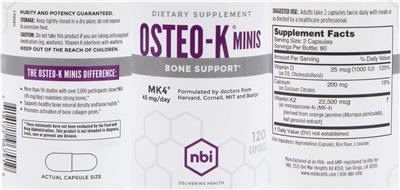
| Vitamin D (as Cholecalciferol, Vitamin D3)1000 IU | 25 mcg | 125% |
| Calcium (as Calcium Citrate) | 200 mg | 15% |
| Vitamin K2 (as Menaquinone-4, Orange Jasmine Leaf Extract)derived from orange jasmine (Murraya paniculata), leaf geraniol extract | 22,500 mcg | † |
Other ingredients: Hypromellose, Rice Flour, L-Leucine
% Daily Values for: Adults and children 4 or more years of age.
Where this label comes from
An original label of the NIH's Dietary Supplement Label Database, entered there on 22 August 2024, shown here as it was entered. The NIH's record · picture of the label (PDF)
General information
- Product name
- Osteo-K Minis
- Brand
- nbi
- Barcode (UPC)
- 7 18122 96791 9
- Net contents
- 120 Capsule(s)
- Market status
- On market
- DSLD ID
- 317252
Classification
- Supplement form
- Capsule
- Product type
- Other Combinations
- Claim types on the label
- Nutrient, All Other, Structure/Function
- Intended for
- Adult (18 - 50 Years)
Label statements
Storage: Storage: Keep tightly closed in a dry place; do not expose to excessive heat.
Precautions: Pregnant or Nursing or Prescription Medications: Caution: Do not take this product if you are taking anticoagulant medication (eg, Warfarin). Vitamin K interferes with Warfarin.
Precautions: Children: Keep out of the reach of children.
FDA Statement of Identity: Dietary Supplement
Formula: Contains: More than 50 studies with over 7,000 mg participants show MK4 (45 mg/day) maintains strong bones. MK4 45 mg/day
Directions: Suggested Use: Adults take 2 capsules twice daily with meals or as directed by a healthcare professional.
Brand information
Manufactured at a FDA- and GMP-registered facility for: NBI, San Diego, CA
More labels from nbi
Labels only: each label is shown as printed on the bottle, with no grades, rankings or advice. A label in this database is not an endorsement of the product. Read the label on the bottle you buy: makers change their formulas. Reverse Age Lab is not affiliated with, or endorsed by, the National Institutes of Health or its Office of Dietary Supplements. The original labels come from the NIH’s public-domain data; the labels since are read by us. Search the Dietary Supplement Label Database.