
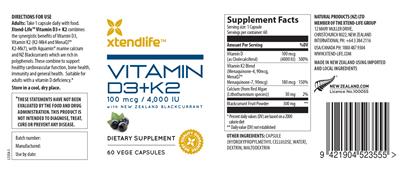
| Vitamin D (as Cholecalciferol)(4000 IU) | 100 mcg | 500% |
| Vitamin K2 Blend | 180 mcg | 150% |
| Menaquinone-4 | 90 mcg | |
| Mena Q7 (as Menaquinone-7) | 90 mcg | |
| Calcium (as Red Algae)lithothamnion species | 30 mg | 2% |
| Black Currant, Powder | 300 mg | † |
Other ingredients: Hydroxypropyl Methylcellulose, Water, Dextrin, Maltodextrin
% Daily Values for: Adults and children 4 or more years of age.
Where this label comes from
An original label of the NIH's Dietary Supplement Label Database, entered there on 25 September 2024, shown here as it was entered. The NIH's record · picture of the label (PDF)
General information
- Product name
- Vitamin D3 4,000 IU + K2 mcg
- Brand
- Xtendlife
- Barcode (UPC)
- 9 421904 523555
- Net contents
- 60 Vege Capsule(s)
- Market status
- On market
- DSLD ID
- 318030
Classification
- Supplement form
- Capsule
- Product type
- Botanical with Nutrients
- Claim types on the label
- Nutrient, All Other, Structure/Function
- Intended for
- Adult (18 - 50 Years)
Label statements
Directions: Directions for use Adults: Take 1 capsule daily with food.
Formula: Contains: Xtend-Life Vitamin D3 + K2 combines the synergistic benefits of Vitamin D3, Vitamin K2 (K2-Mk$ and MenaQ7 K2-Mk7), with Aquamin marine calcium and NZ Blackcurrants which are rich in polyphenols. These combine to support healthy cardiovascular function, bone health, immunity and general health. Suitable for adults with a Vitamin D deficiency.
Storage: Store in a cool, dry place.
Formula: Contains: 100 mcg / 4,000 IU with New Zealand Blackcurrant
FDA Statement of Identity: Dietary Supplement
Brand information
Manufacturer: Natural Products (NZ) LTD Member of the Xtend-Life Group, Christchurch, New Zealand
More labels from Xtendlife
Labels only: each label is shown as printed on the bottle, with no grades, rankings or advice. A label in this database is not an endorsement of the product. Read the label on the bottle you buy: makers change their formulas. Reverse Age Lab is not affiliated with, or endorsed by, the National Institutes of Health or its Office of Dietary Supplements. The original labels come from the NIH’s public-domain data; the labels since are read by us. Search the Dietary Supplement Label Database.