
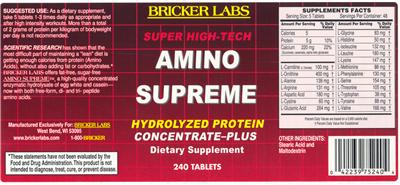
| Calories | 5 {Calories} | 0% |
| Protein | 5 g | 10% |
| Calcium (as Alpha Keto Glutarate, Caseinate, Succinate) | 220 mg | 22% |
| L-Carnitine (as L-Tartrate) | 100 mg | † |
| L-Ornithine | 400 mg | † |
| L-Alanine | 139 mg | † |
| L-Arginine | 131 mg | † |
| L-Aspartic Acid | 180 mg | † |
| Alpha-Glucan Oligosaccharide | 60 mg | † |
| L-Glutamic Acid | 284 mg | † |
| L-Glycine | 83 mg | † |
| L-Histidine | 50 mg | † |
| L-Isoleucine | 132 mg | † |
| L-Leucine | 180 mg | † |
| L-Lysine | 147 mg | † |
| L-Methionine | 88 mg | † |
| L-Phenylalanine | 130 mg | † |
| L-Serine | 154 mg | † |
| L-Threonine | 105 mg | † |
| L-Tryptophan | 38 mg | † |
| L-Tyrosine | 88 mg | † |
| L-Valine | 166 mg | † |
Other ingredients: Stearic Acid, Maltodextrin
% Daily Values for: Adults and children 4 or more years of age.
Where this label comes from
An original label of the NIH's Dietary Supplement Label Database, entered there on 23 December 2011, shown here as it was entered. The NIH's record
General information
- Product name
- Amino Supreme
- Brand
- Bricker Labs
- Barcode (UPC)
- 0 42239 75240 4
- Net contents
- 240 Tablet(s)
- Market status
- On market
- DSLD ID
- 3182
Classification
- Supplement form
- Tablet or Pill
- Product type
- Amino acid/Protein
- Claim types on the label
- Nutrient, All Other
- Intended for
- Adult (18 - 50 Years), Sugar Free
Label statements
FDA Statement of Identity: Dietary Supplement
Directions: Suggested Use: As a dietary supplement, take 5 tablets 1-3 times daily as appropriate and after high intensity workouts. More than a total of 2 grams of protein per kilogram of bodyweight per day is not recommended.
Brand information
Manufactured Exclusively for:: BRICKER LABS, West Bend, WI
More labels from Bricker Labs
Labels only: each label is shown as printed on the bottle, with no grades, rankings or advice. A label in this database is not an endorsement of the product. Read the label on the bottle you buy: makers change their formulas. Reverse Age Lab is not affiliated with, or endorsed by, the National Institutes of Health or its Office of Dietary Supplements. The original labels come from the NIH’s public-domain data; the labels since are read by us. Search the Dietary Supplement Label Database.