
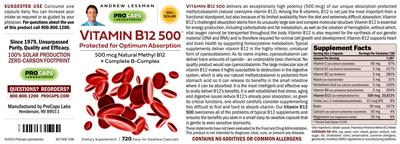
| Vitamin C (as Calcium Ascorbate) | 60 mg | 67% |
| Vitamin B1 (as Thiamine Hydrochloride) | 5 mg | 417% |
| Vitamin B2 (as Riboflavin) | 5 mg | 385% |
| Niacin (as Niacinamide) | 5 mg | 31% |
| Pantothenic Acid (as Calcium Pantothenate) | 5 mg | 100% |
| Vitamin B6 (as Pyridoxine Hydrochloride) | 5 mg | 294% |
| Vitamin B12 (as Methylcobalamin) | 500 mcg | 20,833% |
| Folate (as L-5-Methyltetrahydrofolate) | 33 mcg DFE | 8% |
| Biotin | 50 mcg | 167% |
| Calcium (as Calcium Ascorbate, Calcium Carbonate) | 50 mg | 4% |
| Magnesium (as Magnesium Oxide) | 25 mg | 6% |
Other ingredients: Gelatin, Proprietary Protective Methyl B12 Matrix
% Daily Values for: Adults and children 4 or more years of age.
Where this label comes from
An original label of the NIH's Dietary Supplement Label Database, entered there on 22 November 2024, shown here as it was entered. The NIH's record · picture of the label (PDF)
General information
- Product name
- Vitamin B12 500
- Brand
- ProCaps Laboratories
- Barcode (UPC)
- 527267
- Net contents
- 720 Easy-To-Swallow Capsule(s)
- Market status
- Off market
- DSLD ID
- 320299
Classification
- Supplement form
- Capsule
- Product type
- Multi-Vitamin and Mineral (MVM)
- Claim types on the label
- Nutrient, All Other, Structure/Function
- Intended for
- Adult (18 - 50 Years), No Allergies, Gluten Free, Dairy Free, Sugar Free
Label statements
Directions: Suggested Use Consume one capsule daily. You can increase your intake as required or as guided by your physician.
Formula: Contains: 500 mcg natural methyl B12 + complete B-complex
FDA Statement of Identity: Dietary Supplement
Formula: Contains: Vitamin B12 500 delivers an exceptionally high potency (500 mcg) of our unique absorption-protected methylcobalamin (natural coenzyme vitamin B12). Among the B-vitamins, B12 is not just the most important from a functional standpoint, but also because of its limited availability from the diet and extremely difficult absorption. Vitamin B12’s challenged absorption stems from its unusually large size and complex molecular structure. Vitamin B12 is essential for energy production, including carbohydrate and fat metabolism, as well as the creation of hemoglobin, without which, vital oxygen cannot be transported throughout the body. Vitamin B12 is also required for the synthesis of our genetic material (DNA and RNA) and is therefore required for normal cell growth and development. Vitamin B12 supports heart and brain health by supporting homocysteine metabolism. Typical supplements deliver vitamin B12 in the highly inferior, unnatural form of cyanocobalamin. As its name implies, cyanocobalamin can deliver trace amounts of cyanide – an undesirable toxic chemical. No quality product would use cyanocobalamin. The large molecular size of vitamin B12 makes it highly susceptible to destruction in the digestive system, which is why our natural methylcobalamin is protected from stomach acid so it can release its benefits in the small intestine where it can be absorbed. It is the most intelligent and effective way to orally deliver B12’s benefits. It is well-established that stress, aging and digestive issues reduce B12’s already poor absorption, so given its critical functions, one should carefully consider supplementing this difficult to find and hard to absorb vitamin.
Formulation: Does NOT Contain: Contains no additives or common allergens Contains no milk, soy, yeast, corn, wheat, gluten, sodium, salt, sugar, fat, cholesterol, color, preservative, common allergens, genetically modified (GMO) ingredients or manufacturing additives.
Brand information
Manufactured by: ProCaps Labs, Henderson, NV
More labels from ProCaps Laboratories
Labels only: each label is shown as printed on the bottle, with no grades, rankings or advice. A label in this database is not an endorsement of the product. Read the label on the bottle you buy: makers change their formulas. Reverse Age Lab is not affiliated with, or endorsed by, the National Institutes of Health or its Office of Dietary Supplements. The original labels come from the NIH’s public-domain data; the labels since are read by us. Search the Dietary Supplement Label Database.