
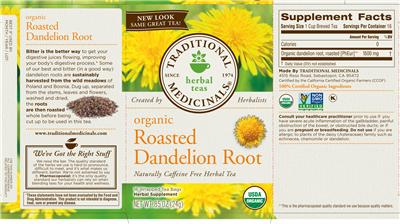
| Calories | 0 {Calories} | |
| Organic dandelionOrganic dandelion PlantPart: root Note: roasted (PhEur) This is the pharmacopoeial quality standard we use because quality matters. | 1,500 mg | † |
% Daily Values for: Adults and children 4 or more years of age.
Where this label comes from
An original label of the NIH's Dietary Supplement Label Database, entered there on 25 April 2014, shown here as it was entered. The NIH's record
General information
- Product name
- Organic Roasted Dandelion Root
- Brand
- Traditional Medicinals
- Barcode (UPC)
- Not printed
- Net contents
- 16 Wrapped Tea Bag(s); 0.85 oz.; 24 Gram(s)
- Market status
- Off market
- DSLD ID
- 32060
Classification
- Supplement form
- Other (e.g. tea bag)
- Product type
- Botanical
- Claim types on the label
- All Other, Structure/Function
- Intended for
- Adult (18 - 50 Years), Kosher, Organic
Label statements
Precautions: Pregnant or Nursing or Prescription Medications: Consult your healthcare practitioner prior to use if: you have severe acute inflammation of the gallbladder, painful obstruction of the bowel, or obstructed bile ducts; or if you are pregnant or breast feeding.
Precautions: Allergies: Do not use if you are allergic to plants of the daisy (Asteraceae) family such as echinacea, chamomile or dandelion.
Formulation: Does NOT Contain: Naturally Caffeine Free Herbal Tea
FDA Statement of Identity: Herbal Supplement
Brand information
Made by: TRADITIONAL MEDICINALS, Sebastopol, CA
More labels from Traditional Medicinals
Labels only: each label is shown as printed on the bottle, with no grades, rankings or advice. A label in this database is not an endorsement of the product. Read the label on the bottle you buy: makers change their formulas. Reverse Age Lab is not affiliated with, or endorsed by, the National Institutes of Health or its Office of Dietary Supplements. The original labels come from the NIH’s public-domain data; the labels since are read by us. Search the Dietary Supplement Label Database.