
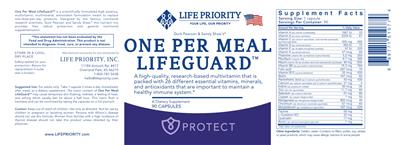
| Vitamin A (as Vitamin A Palmitate) | 1,667 IU | 33% |
| Vitamin A (as Beta-Carotene) | 3,333 IU | 67% |
| Vitamin C (as Ascorbyl Palmitate, Calcium Ascorbate, Niacinamide Ascorbate) | 300 mg | 500% |
| Vitamin D (as Cholecalciferol) | 300 IU | 75% |
| Vitamin E (as DL-Alpha-Tocopheryl Acetate) | 67 IU | 220% |
| Vitamin K (as Phytonadione) | 47 mcg | 60% |
| Thiamine (as Thiamine Hydrochloride, Vitamin B1) | 5.2 mg | 350% |
| Riboflavin (as Vitamin B2) | 6.7 mg | 390% |
| Niacin (as Vitamin B3) | 40 mg | 200% |
| Vitamin B6 (as Pyridoxine Hydrochloride) | 15.3 mg | 760% |
| Folic Acid | 267 mcg | 70% |
| Vitamin B12 (as Cyanocobalamin) | 33 mcg | 550% |
| Biotin | 167 mcg | 60% |
| Pantothenic Acid (as Calcium D-Pantothenate) | 43 mg | 430% |
| Calcium (as Calcium Ascorbate, D-Calcium Pantothenate) | 31 mg | 4% |
| Iodine (as Potassium Iodide) | 50 mcg | 35% |
| Zinc (as Zinc Gluconate) | 11.7 mg | 80% |
| Selenium (as Sodium Selenite) | 57 mg | 80% |
| Copper (as Copper Bisglycinate) | 1 mg | 50% |
| Manganese (as Manganese Bisglycinate) | 833 mcg | 40% |
| Chromium (as Chromium Nicotinate Glycinate) | 67 mcg | 60% |
| Molybdenum (as Molybdenum Glycinate) | 167 mcg | 220% |
| Taurine | 50 mg | † |
| L-Cysteine Hydrochloride | 33 mg | † |
| Quercetin | 17 mg | † |
| Boron (as Calcium Bororganic Glycine) | 1 mg | † |
Other ingredients: Gelatin, Water
% Daily Values for: Adults and children 4 or more years of age.
Where this label comes from
An original label of the NIH's Dietary Supplement Label Database, entered there on 22 November 2024, shown here as it was entered. The NIH's record · picture of the label (PDF)
General information
- Product name
- One Per Meal Lifeguard
- Brand
- Life Priority
- Barcode (UPC)
- 6 89771 51077 4
- Net contents
- 90 Capsule(s)
- Market status
- On market
- DSLD ID
- 320760
Classification
- Supplement form
- Capsule
- Product type
- Other Combinations
- Claim types on the label
- Nutrient, All Other, Structure/Function
- Intended for
- Adult (18 - 50 Years), Women (not pregnant or lactating)
Label statements
Storage: Store in a cool, dry place.
Precautions: Allergies: Safety sealed for your protection. Return for replacement if outer seal is broken.
Precautions: Children: Suggested Use: For adults only.
Directions: Suggested Use: For adults only. Take 1 capsule 3 times a day immediately after meals as a dietary supplement.
Precautions: All Other: The niacin content of One Per Meal LifeGuard may cause temporary skin flushing, redness, a feeling of heat, and itching which usually last for about a half hour. This niacin flush is harmless and can be minimized by taking the capsules on a full stomach.
Precautions: Children: Caution: Keep out of reach of children. Not for use by children or pregnant or lactating women.
Precautions: All Other: Use only as directed. Persons with Wilson's disease should not use this formula. Women from families with a high incidence of thyroid disease should not take this product unless directed by their physician.
Precautions: Pregnant or Nursing or Prescription Medications: Not for use by children or pregnant or lactating women.
Formula: Contains: A high-quality, research-based multivitamin that is packed with 26 different essential vitamins, minerals, and antioxidants that are important to maintain a healthy immune system.
FDA Statement of Identity: A Dietary Supplement
Formulation: Does NOT Contain: Contains no fillers, pollen, soy wheat, or yeast products, which may cause allergic reaction in some people.
Brand information
Manufactured exclusively for and Distributed by: Life Priority, Inc., Overland Park, KS
More labels from Life Priority
Labels only: each label is shown as printed on the bottle, with no grades, rankings or advice. A label in this database is not an endorsement of the product. Read the label on the bottle you buy: makers change their formulas. Reverse Age Lab is not affiliated with, or endorsed by, the National Institutes of Health or its Office of Dietary Supplements. The original labels come from the NIH’s public-domain data; the labels since are read by us. Search the Dietary Supplement Label Database.