
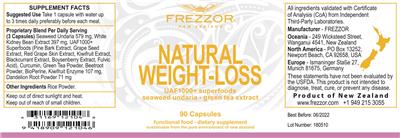
| Proprietary Blendper daily serving | ||
| Seaweed Undaria | 579 mg | |
| White Kidney Bean extract | 397 mg | |
| UAF1000+ Superfoods | ||
| Pine Bark Extract | ||
| Grape Seed Extract | ||
| Red Grape skin extract | ||
| Kiwifruit extract | ||
| Blackcurrant extract | ||
| Boysenberry Extract | ||
| Fulvic Acid | ||
| Curcumin | ||
| Green Tea, Powder | ||
| Beetroot, Powder | ||
| Bioperine | ||
| Kiwifruit Enzyme | 107 mg | |
| Dandelion, Powder | 71 mg |
Other ingredients: Rice, Powder
% Daily Values for: Adults and children 4 or more years of age.
Where this label comes from
An original label of the NIH's Dietary Supplement Label Database, entered there on 22 November 2024, shown here as it was entered. The NIH's record · picture of the label (PDF)
General information
- Product name
- Natural Weight-Loss
- Brand
- FREZZOR
- Barcode (UPC)
- 6 31169 12104 8
- Net contents
- 90 Capsule(s)
- Market status
- On market
- DSLD ID
- 320800
Classification
- Supplement form
- Capsule
- Product type
- Other Combinations
- Claim types on the label
- All Other, Structure/Function
- Intended for
- Adult (18 - 50 Years)
Label statements
Directions: Suggested use Take 1 capsule with water up to 3 times daily preferably before each meal.
Storage: Keep out of direct sunlight and heat.
Precautions: Children: Keep out of reach of small children.
Formula: Contains: UAF1000+ superfoods Seaweed undaria Green tea extract
FDA Statement of Identity: Dietary Supplement
Brand information
Manufacturer: FREZZOR North America, Newport Beach, CA, USA
Manufacturer: FREZZOR Oceania, Wanganui 4541, New Zealand
Manufacturer: FREZZOR Europe, Munich, Germany
More labels from FREZZOR
Labels only: each label is shown as printed on the bottle, with no grades, rankings or advice. A label in this database is not an endorsement of the product. Read the label on the bottle you buy: makers change their formulas. Reverse Age Lab is not affiliated with, or endorsed by, the National Institutes of Health or its Office of Dietary Supplements. The original labels come from the NIH’s public-domain data; the labels since are read by us. Search the Dietary Supplement Label Database.