
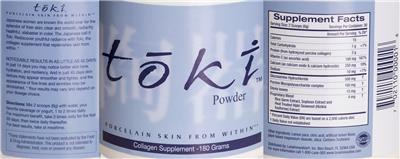
| Calories | 15 | |
| Total Carbohydrates | 1 g | <1% |
| Protein (as Porcine Collagen, Hydrolyzed) | 3 g | |
| Vitamin C (as Ascorbic Acid) | 150 mg | 167% |
| Calcium (as Calcium Hydroxide, Calcium Oxide) | 250 mg | 19% |
| Sodium | 10 mg | <1% |
| Glucosamine Hydrochloride | 500 mg | † |
| Porcine Mucopolysaccharide Complex | 160 mg | † |
| Stevia | 15 mg | † |
| Proprietary Blend | 4 mg | † |
| Rice Germ Extract | ||
| Soybean Extract | ||
| Hijiki Seaweed Extract (as Hizikia fusiforme Extract)heat treated |
Other ingredients: Lemon Juice, Citric Acid, artificial Lemon flavor, Magnesium Stearate, Silica
% Daily Values for: Adults and children 4 or more years of age.
Where this label comes from
An original label of the NIH's Dietary Supplement Label Database, entered there on 22 November 2024, shown here as it was entered. The NIH's record · picture of the label (PDF)
General information
- Product name
- Toki Powder
- Brand
- LaneInnovative
- Barcode (UPC)
- 7 02110 00001 6
- Net contents
- 180 Gram(s)
- Market status
- On market
- DSLD ID
- 321189
Classification
- Supplement form
- Powder
- Product type
- Other Combinations
- Claim types on the label
- All Other, Structure/Function
- Intended for
- Adult (18 - 50 Years)
Label statements
Directions: Directions: Mix 2 scoops (6g) with water, your favorite beverage or yogurt, 1 to 2 times daily. For maximum benefit, take 3 times daily for the first 30 days, then twice daily thereafter. For best results, take at mealtime.
FDA Statement of Identity: Collagen Supplement
Precautions: All Other: Your results may very and depend on your dosage choice.
Brand information
Distributed by: LaneInnovative, Inc., Vero Beach, FL, USA
More labels from LaneInnovative
Labels only: each label is shown as printed on the bottle, with no grades, rankings or advice. A label in this database is not an endorsement of the product. Read the label on the bottle you buy: makers change their formulas. Reverse Age Lab is not affiliated with, or endorsed by, the National Institutes of Health or its Office of Dietary Supplements. The original labels come from the NIH’s public-domain data; the labels since are read by us. Search the Dietary Supplement Label Database.