
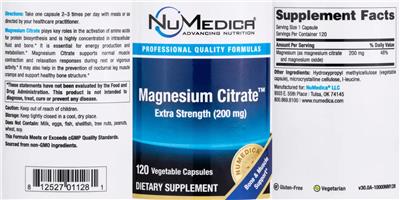
| Magnesium (as Magnesium Citrate, Magnesium Oxide) | 200 mg | 48% |
Other ingredients: Hydroxypropylmethylcellulose, Microcrystalline Cellulose, L-Leucine
% Daily Values for: Adults and children 4 or more years of age.
Where this label comes from
An original label of the NIH's Dietary Supplement Label Database, entered there on 23 February 2025, shown here as it was entered. The NIH's record · picture of the label (PDF)
General information
- Product name
- Magnesium Citrate Extra Strength 200 mg
- Brand
- NuMedica
- Barcode (UPC)
- 8 12527 01128 1
- Net contents
- 120 Vegetable Capsule(s)
- Market status
- On market
- DSLD ID
- 323568
Classification
Label statements
Directions: Directions: Take one capsule 2-3 times per day with meals or as directed by your healthcare practitioner.
Formula: Contains: Magnesium Citrate plays key roles in the activation of amino acids for protein biosynthesis and is highly concentrated in intracellular fluid and bone. It is essential for energy production and metabolism. Magnesium Citrate supports normal muscle contraction and relaxation responses during rest or vigorous activity. It may also help in the prevention of nocturnal leg muscle cramps and support healthy bone structure.
Precautions: Children: Caution: Keep out of reach of children.
Storage: Storage: Keep tightly closed in a cool, dry place.
Formulation: Does NOT Contain: Does not contain: Milk, eggs, fish, shellfish, tree nuts, peanuts, wheat, soy.
Formulation: Does NOT Contain: Sourced from non-GMO ingredients.
FDA Statement of Identity: Dietary Supplement
Formulation: Does NOT Contain: GF Gluten-Free
Brand information
Manufactured for: NuMedica LLC, Tulsa, OK
More labels from NuMedica
Labels only: each label is shown as printed on the bottle, with no grades, rankings or advice. A label in this database is not an endorsement of the product. Read the label on the bottle you buy: makers change their formulas. Reverse Age Lab is not affiliated with, or endorsed by, the National Institutes of Health or its Office of Dietary Supplements. The original labels come from the NIH’s public-domain data; the labels since are read by us. Search the Dietary Supplement Label Database.