| Valerian | 470 mg | † |
Other ingredients: Cellulose
% Daily Values for: Adults and children 4 or more years of age.
Where this label comes from
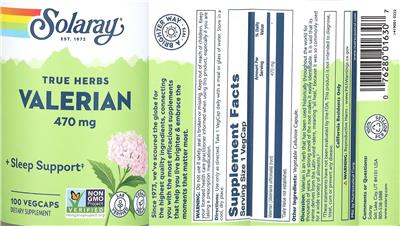
An original label of the NIH's Dietary Supplement Label Database, entered there on 24 April 2025, shown here as it was entered. The NIH's record · picture of the label (PDF)
General information
- Product name
- Valerian 470 mg
- Brand
- Solaray
- Barcode (UPC)
- 0 76280 01630 7
- Net contents
- 100 VegCap(s)
- Market status
- On market
- DSLD ID
- 326143
Classification
Label statements
Formula: Contains: True Herbs
FDA Statement of Identity: Dietary Supplement
Formulation: Does NOT Contain: Non GMO Project Verified nongmoproject.org
Precautions: All Other: Warning: Do not use if safety seal is broken or missing.
Precautions: Children: Keep out of reach of children.
Precautions: Pregnant or Nursing or Prescription Medications: Keep your licensed health care practitioner informed when using this product, especially if you are taking prescription medication.
Directions: Directions: Use only as directed. Take 1 VegCap twice daily with a meal or glass of water.
Directions: Store in a cool, dry place.
Formula: Contains: Discussion: Valerian is an herb that has been used historically throughout the world for thousands of years. The strong smell of the root makes it easily identifiable. It is said that its name derives from the Latin word valere, meaning "all heal," because it was so commonly used for wide variety of ailments.
Precautions: All Other: California Residents Only Warning: Reproductive Harm - www.P65Warnings.ca.gov
Brand information
Manufactured by: Nutraceutical Corp.
Comments or Questions: Solaray, Salt Lake City, UT, USA
More labels from Solaray
Labels only: each label is shown as printed on the bottle, with no grades, rankings or advice. A label in this database is not an endorsement of the product. Read the label on the bottle you buy: makers change their formulas. Reverse Age Lab is not affiliated with, or endorsed by, the National Institutes of Health or its Office of Dietary Supplements. The original labels come from the NIH’s public-domain data; the labels since are read by us. Search the Dietary Supplement Label Database.