
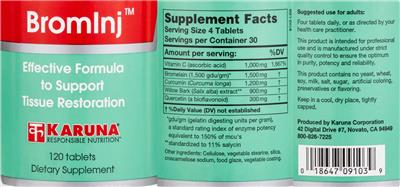
| Vitamin C (as Ascorbic Acid) | 1,000 mg | 1,667% |
| Bromelain1,500 gdu/gm (gelatin digesting units per gram), a standard rating index of enzyme potency equivalent to 150% of mcu's | 1,500 mg | † |
| Curcumin (as Curcuma longa) | 1,200 mg | † |
| Willow Bark Extract (as Salix alba Bark Extract)standardized to 11% salicin | 900 mg | † |
| Quercetina bioflavonoid | 300 mg | † |
Other ingredients: Cellulose, Vegetable Stearine, Silica, Croscarmellose Sodium, Food Glaze, Vegetable Coating
% Daily Values for: Adults and children 4 or more years of age.
Where this label comes from
An original label of the NIH's Dietary Supplement Label Database, entered there on 23 February 2025, shown here as it was entered. The NIH's record · picture of the label (PDF)
General information
- Product name
- Bromlnj
- Brand
- Karuna
- Barcode (UPC)
- 0 18647 09103 9
- Net contents
- 120 Tablet(s)
- Market status
- On market
- DSLD ID
- 327081
Classification
- Supplement form
- Tablet or Pill
- Product type
- Other Combinations
- Claim types on the label
- All Other, Structure/Function
- Intended for
- Adult (18 - 50 Years), Dairy Free, Sugar Free
Label statements
FDA Statement of Identity: Dietary Supplement
Directions: Suggested use for adults: Four tablets daily, or as directed by your health care practitioner.
Precautions: All Other: This product is intended for professional use and is manufactured under strict quality control to ensure the optimum in purity, potency and reliability.
Formulation: Does NOT Contain: This product contains no yeast, wheat, soy, milk, salt, sugar, artificial coloring, preservatives or flavoring.
Storage: Keep in a cool, dry place, tightly capped.
Brand information
Produced by: Karuna Corporation, Novato, CA
More labels from Karuna
Labels only: each label is shown as printed on the bottle, with no grades, rankings or advice. A label in this database is not an endorsement of the product. Read the label on the bottle you buy: makers change their formulas. Reverse Age Lab is not affiliated with, or endorsed by, the National Institutes of Health or its Office of Dietary Supplements. The original labels come from the NIH’s public-domain data; the labels since are read by us. Search the Dietary Supplement Label Database.