
Vitamin D3 1000 plus Calcium Intensive Care
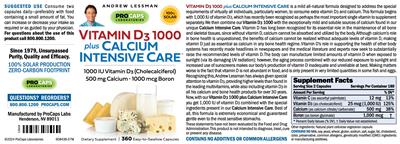
| Vitamin C (as Ascorbyl Palmitate) | 12 mg | 13% |
| Vitamin D3 (as Cholecalciferol)1,000 IU | 25 mcg | 125% |
| Calcium (as Calcium Carbonate, Calcium Citrate) | 500 mg | 38% |
| Boron (as Boron Glycinate) | 1,000 mcg | † |
Other ingredients: Cellulose
% Daily Values for: Adults and children 4 or more years of age.
Where this label comes from
An original label of the NIH's Dietary Supplement Label Database, entered there on 21 May 2025, shown here as it was entered. The NIH's record · picture of the label (PDF)
General information
- Product name
- Vitamin D3 1000 plus Calcium Intensive Care
- Brand
- ProCaps Laboratories
- Barcode (UPC)
- 836921
- Net contents
- 360 Easy-To-Swallow Capsule(s)
- Market status
- On market
- DSLD ID
- 331619
Classification
- Supplement form
- Capsule
- Product type
- Multi-Vitamin and Mineral (MVM)
- Claim types on the label
- Nutrient, All Other, Structure/Function
- Intended for
- Adult (18 - 50 Years), No Allergies, Gluten Free, Dairy Free, Sugar Free
Label statements
Directions: Suggested Use Consume two capsules daily - preferably with food containing a small amount of fat. You can increase or decrease your intake as required or as guided by your physician.
Formula: Contains: 1000 IU Vitamin D3 (cholecalciferol) 500 mg calcium 1000 mcg boron
FDA Statement of Identity: Dietary Supplement
Formula: Contains: Vitamin D3 1000 plus Calcium intensive care is a mild all-natural formula designed to address the special requirements of virtually all individuals, particularly women, to consume extra vitamin D3 and calcium. This formula begins with 1,000 IU of vitamin D3, which has recently been recognized as perhaps the most important single vitamin to supplement separately. We then combine our Vitamin D3 1000 with the exceptionally mild and soluble sources of calcium found in our unique Calcium Intensive Care. Vitamin D has long been recognized for its essential role in the maintenance of all bone and skeletal tissues, since without vitamin D, calcium cannot be absorbed and utilized by the body. Although calcium’s role in bone health is unquestioned, the benefits of calcium cannot be realized without adequate levels of vitamin D, making vitamin D just as essential as calcium in any bone health regime. Vitamin D’s role in supporting the health of other body systems has recently made headlines in newspapers and the medical literature and experts now seek to substantially raise the recommended levels of vitamin D. The body can manufacture limited amounts of vitamin D when exposed to sunlight (via its damaging UV radiation); however, the aging process combined with our reduced exposure to sunlight and increased use of sunscreens makes our body’s production of vitamin D inadequate and unreliable at best. Making matters worse is the fact that vitamin D is not abundant in food, and is only present in very limited quantities in some fish and eggs. Recognizing this, Andrew Lessman has always given special attention to vitamin D3, providing higher levels than found in the leading multivitamins, while also including vitamin D3 in all his calcium and bone health products for over 30 years. Now, with our Vitamin D3 1000 plus Calcium Intensive Care you get 1,000 IU of vitamin D3 combined with the special ingredients present in our Calcium Intensive Care.
Formulation: Does NOT Contain: Contains no additives or common allergens Contains no milk, soy, yeast, wheat, gluten, sodium, salt, sugar, fat, cholesterol, color, preservative, common allergens, genetically modified (GMO) ingredients or manufacturing additives.
Brand information
Manufactured by: ProCaps Labs, Henderson, NV
More labels from ProCaps Laboratories
Labels only: each label is shown as printed on the bottle, with no grades, rankings or advice. A label in this database is not an endorsement of the product. Read the label on the bottle you buy: makers change their formulas. Reverse Age Lab is not affiliated with, or endorsed by, the National Institutes of Health or its Office of Dietary Supplements. The original labels come from the NIH’s public-domain data; the labels since are read by us. Search the Dietary Supplement Label Database.